

576. 7x3. Vierde instalraam in een reeks zeven. Locatie Zilverhof 34. Oktober 2018.

encyclopedia
This encyclopedia offers a splendid and wildly recommendable insight in the world of Croxhapox, combining trivial pursuit and serious matter. The entries have been mostly written in Dutch but quite a few have been translated. If you want the Dutch original, change your choice of language and go to the 'encyclopedie'.
--> HAP
INTIMITEIT VERSUS CRASH - Luk Lambrecht, De Morgen 23 april 1999. Galerie Croxhapox in Gent houdt er met één tentoonstelling per maand een hels tempo op na. Deze keer bracht Croxhapox-bezieler en kunstenaar Hans van Heirseele twee tegengestelde presentaties bij elkaar. Het werk van de Amerikaanse Wendy Hirschberg (°1955) is er één van en bestaat uit kleine, vrij brave en traditioneel gepresenteerde assemblages. --- Anders en beter is de tentoonstelling van de Gentse Lieve D'hondt (°1963). Het is een reeks van prachtige collages en tekeningen die zinspelen op een voortdurende recyclage van beelden. Die komen uit haar, inmiddels grote, oeuvre en worden gecombineerd met materiaal uit populaire magazines. Centraal in haar expositie staat een video zonder geluid waarop de zinnetjes 'What about time' en 'What about silence' keer op keer verschijnen. De felwitte, beeldloze stills tussen de projectie van de citaten beschouwt zij als licht, een lamp of gewoon: als een wit scherm. In de hoek van de kamer staat een stoel waarop je kan reflecteren over die veelzeggende, 'minimale' zinnetjes./ De productie van D'hondt zoekt geen spektakel maar laat de meest uiteenlopende beelden als het ware imploderen, met als resultaat een epos over haar kunst en over wereldse zaken, waaronder een reeks zwembaden en hotelkamers. Op grote bladen kleeft ze gekopieerde sequenties uit haar vroeger videowerk, ordelijk naast elkaar als een nieuwe opeenvolging van beelden in zwart-wit. Op die manier creëert ze afstand tot haar artistiek verleden./ Die strategie wordt nog duidelijker in werk waarin ze beelden uit haar video's schematiseert in tekeningen met een pseudowetenschappelijk trekje. D'hondt analyseert en registreert heel nauwkeurig en per thema wat ze ziert op haar videofilms. Ze combineert die informatie met woorden of stukjes van woorden. Kunst is gebaseerd op codes - het is fascinerend om die codes af te tasten en af en toe te kraken./ Een van haar mooiste werken is een tekening die ooit een indrukwekkende muurinstallatie moet worden. een grote metalen plaat wordt dan de drager van een transparante vleugel in plexiglas die als een boek in de ruimte uitwaaiert. Rond dat werk worden zes rode contouren getrokken, die de ruimtelijkheid benadrukken. Op de prachtige tekening is een citaat te lezen dat tot ieders verbeelding kan spreken: 't was certain because of the distance. D'hondt bewijst zo haar talent om met minimale middelen tot een subtiele inhoudelijke gelaagdheid te komen. (LL)
INTIMACY VERSUS CRASH [INTIMITEIT VERSUS CRASH] - Luk Lambrecht, De Morgen 23 April 1999. Galerie Croxhapox in Ghent keeps up a devellish pace with one new exhibition a month. This time, Croxhapox driving force and artist Hans van Heirseele presents two ensembles in counterpoint. The work of American artist Wendy Hirschberg (°1955) is one of them and consists of smallish, rather 'nice' and traditionally presented assemblages. --- Different and a lot better is the show by Ghent artist Lieve D'hondt (°1963). It consists of a series of magnificent collages and drawings referring to a continuous recycling of images. They originate in her quite large oeuvre and are combined with material from popular magazines. Centrally to her exhibition is a silent video where the sentences 'What about time' and 'What about silence' appear over and over again. The harsh whiteimageless stills in between the sentences she considers to be just a light, a lamp, or simply a white screen. In a corner of the room is a chair where one can reflect on the meaning of those eloquent, 'minimal' phrases./ D'hondt's production doesn't aim at spectacular experiences but lets so to speak implode a wide range of images, resulting in an epos about her art and about worldly things like swimming pools or hotel rooms. She sticks copied sequences from previous video works on large sheets, nicely lined up like a new concatenation of b/w images. In this way, she creates a distance between this and her artistic past./ This strategy even becomes more clear in those pieces where she shows schematical reductions of video images as drawings with a touch of pseudo science. D'hondt analyses and registers very precisely and thematically what she sees in her videos. She combines that information with words or fragments of words. Art is about codes - it is fascinating to explore these codes and sometimes even to crack them./ One of her most astounding works is a drawing which is meant to become an impressive wall painting. A large metal plate then turns into the carrier of a transparant perspex wing which unfolds in space like a book. Six red shapes around that work emphasize its spatiality. A quote on the magnificent drawing speaks to anyone's imagination: 't was certain because of the distance. In these works D'hondt testifies to her talent for reaching subtle layers of meaning with a minimum of means. (LL)
51. OPEN DEUREN 1996. Een locatie in de Toekomststraat.
95. Solo presentatie in de beletage van Aannemersstraat 54. 1999. Recensie Luk Lambrecht.
124. Instalraam Onderstraat 26. 2004.
145-1. BASICS 2. 2005. 145–1
145–1
145-2. BASICS 2. 2006. Abdij Maagededale, Oudenaarde.
crox-card 40. Ki. 2006.
188. BRAINBOX 1–5. 2006. Pieter Vermeersch, Lieve D'hondt en Eva-Maria Bogaert. Recensies in H-art en Zone 09.
564. PAST THE HARD EDGES AND STRAIGHT LINES TO THE CURVES AND INTERSECTIONS BELOW. Zeventien robots 5. 2017. In een beperkte oplage van 49 exemplaren. Geprint op maco wit [in het crox-archief 1 exemplaar op een papier met zachtere toon]. Boekpresentatie 17 maart 2018, Zilverhof 34.
607. KUNST & ZWALM 2021. Locatie O. A pair of images for Caildenberg.
KUNST & ZWALM from the catalogue
In het werk van Lieve D'hondt komen de klassieke werkprocessen van beeldhouwen, tekenen en architectuur aan bod, waarbij de grenzen tussen de verschillende disciplines vervagen. De multimedia-interventies en installaties bespelen parameters als aan-/afwezigheid, tijd, ruimte, codes en verschijningsvormen. Constructie en reconstructie van structuren verwijzen subtiel naar het preceptiueproces en de culturele context. Recente projecten g-focussen op het bespelen van ruimte en het interpreteren van haar beleving, betekenis en inhoud. De materiaalkeuze en de plaatsing van de elementen ten opzichte van elkaar en in de ruimte zijn weloverwogen gecomponeerd. O
Via een zijpad aan de Caildenberg ontdek je het werk van Lieve in een verborgen paradijsje, een verlaten kleine boomgaard. Alle zintuigen worden aangesproken. Het werk bestaat uit twee bewerkte foto's, geprint op aluminium, opgesteld tussen de bomen. De bewerking toont de gefragmenteerde opbouw van het fotografische beeld. De afstand en de plaats die de toeschouwer inneemt ten opzichte van beide kunstwerken is medebepalend, in de perceptie, in de reflectie, in de ervaring, in het avontuur van het kijken. De samenhang van lichtweerkaatsingen en schaduwspel door de bladeren, veroorzaakt door natuurelementen als zon, wind en eventueel regen, zorgen ervoor dat de rasterfragmenten op het aluminium vlak veranderende beeldvormingen genereren. Ook het moment van de dag, ochtend, middag of avond, beïnvloeden het werk. Het weerspiegelende tweeluik, een verstilde beweging in een bewegende stilte.
vraag en antwoord from the catalogue
What would you like to do more often?
Lezen. Reizen. Films bekijken. Muziek beluisteren. Zwemmen
What does collaboration mean for your work?
In dialoog gaan, uitdaging, verbreden, ontdekken, vernieuwen, directe communicatie ...
What touches / touched you in Zwalm?
Rust. Weinig volk. Eenheid. Weinig kleur. Verschillende zichten en uitzichten, vergezichten. Open ruimte. Heuvelachtige panorama's. Landbouw en velden. Typisch Belgische architectuur
What do you value most in your friends?
Eerlijkheid. Open mind. Respect. Reflectie. Verbinding. Interactie. Goed gesprek. Plezier
What can a community and outsiders offer each other?
Plezier. Verwondering. Nieuwe invalshoeken. Perspectieven. Elementen om over na te denken
What is your favorite tea?
Depends of the moment of the day and where I am. Natural teas
What is participation for you?
Betrokkenheid. Dialoog. Connectie. Constructieve interactie. Loyaliteit
What do you need?
– to feel good: sun, light, water, healthy body, fun, happiness
– positieve energie: mentaal en fysiek
– kunst, cultuur, natuur
– input
– zwemmen
– beweging
What dialogue do you have with your/the environment?
Small interventions and actions. Observations. Taking care. Beauty
What was the last book you read?
Een schrijver waar ik steeds naar teruggrijp is Julio Cortazar. Een bijzondere en mooie man. (ivm de blik, het kijken, relaties en verbanden, ervaringen, verwondering) Nu lees ik een boek dat ik gekregen en gekozen heb: De jaren, Annie Ernaux.
Het boek begint met een opsomming van waarnemingen, constateringen, overdenkingen, mijmeringen, korte beelden en schetsen.
What is a condition for a conversation to you?
Open mind. Belangstelling. Nieuwsgierigheid. De persoon zelf om mee in gesprek te gaan vind ik belangrijk.
What question(s) do you ask?
What about art? Past, now and future
What about life?
Vragen uit bezorgdheid en interesse in groter geheel. (micro_macro)
Vragen ivm inzicht en begrip, kader en context.
Please, could you share a note you wrote in the past few months?
Ik schrijf niet dikwijls, en niet veel, en enkel als het nodig is of gevraagd wordt. Ik werk met schema's en opsommingen, linken en verbanden, en mind maps.
 158
158crox-card 158. Verschuivingen-RB. 2021.
INTIMACY VERSUS CRASH [INTIMITEIT VERSUS CRASH] - Luk Lambrecht, De Morgen 23 April 1999. Galerie Croxhapox in Ghent keeps up a devellish pace with one new exhibition a month. This time, Croxhapox driving force and artist Hans van Heirseele presents two ensembles in counterpoint. The work of American artist Wendy Hirschberg (°1955) is one of them and consists of smallish, rather 'nice' and traditionally presented assemblages. --- Different and a lot better is the show by Ghent artist Lieve D'hondt (°1963). It consists of a series of magnificent collages and drawings referring to a continuous recycling of images. They originate in her quite large oeuvre and are combined with material from popular magazines. Centrally to her exhibition is a silent video where the sentences 'What about time' and 'What about silence' appear over and over again. The harsh whiteimageless stills in between the sentences she considers to be just a light, a lamp, or simply a white screen. In a corner of the room is a chair where one can reflect on the meaning of those eloquent, 'minimal' phrases./ D'hondt's production doesn't aim at spectacular experiences but lets so to speak implode a wide range of images, resulting in an epos about her art and about worldly things like swimming pools or hotel rooms. She sticks copied sequences from previous video works on large sheets, nicely lined up like a new concatenation of b/w images. In this way, she creates a distance between this and her artistic past./ This strategy even becomes more clear in those pieces where she shows schematical reductions of video images as drawings with a touch of pseudo science. D'hondt analyses and registers very precisely and thematically what she sees in her videos. She combines that information with words or fragments of words. Art is about codes - it is fascinating to explore these codes and sometimes even to crack them./ One of her most astounding works is a drawing which is meant to become an impressive wall painting. A large metal plate then turns into the carrier of a transparant perspex wing which unfolds in space like a book. Six red shapes around that work emphasize its spatiality. A quote on the magnificent drawing speaks to anyone's imagination: 't was certain because of the distance. In these works D'hondt testifies to her talent for reaching subtle layers of meaning with a minimum of means. (LL)
51. OPEN DEUREN (1996). A venue in Toekomststraat.
95. Drawings and video collages (1999). Review Luk Lambrecht (DM) [see above]. The other solo presentation, in the basement, is a project by Wendy Hirschberg (US).
124. Window project (2004). Location: Onderstraat 26.
145-1. BASICS 2 (2005). ==>still life
145-2. BASICS 2 (2006). Sequel abbey Maagededale, Oudenaarde.
crox-card 40, Ki (2006).
188. BRAINBOX unit 5 (2006). With Pieter Vermeersch and Eva-Maria Bogaert. Reviews in H-art and Zone 09.
564. PAST THE HARD EDGES AND STRAIGHT LINES TO THE CURVES AND INTERSECTIONS BELOW. Zeventien Robots [Seventeen Robots] 5 (2018). A limited edition of 49 specimen, signed and numbered each. Book presentation on 17 March 2018 at Zilverhof 34.
607. A PAIR OF IMAGES FOR CAILDENBERG. Kunst & Zwalm (2021).
KUNST & ZWALM from the catalogue
In het werk van Lieve D'hondt komen de klassieke werkprocessen van beeldhouwen, tekenen en architectuur aan bod, waarbij de grenzen tussen de verschillende disciplines vervagen. De multimedia-interventies en installaties bespelen parameters als aan-/afwezigheid, tijd, ruimte, codes en verschijningsvormen. Constructie en reconstructie van structuren verwijzen subtiel naar het preceptiueproces en de culturele context. Recente projecten g-focussen op het bespelen van ruimte en het interpreteren van haar beleving, betekenis en inhoud. De materiaalkeuze en de plaatsing van de elementen ten opzichte van elkaar en in de ruimte zijn weloverwogen gecomponeerd. O
Via een zijpad aan de Caildenberg ontdek je het werk van Lieve in een verborgen paradijsje, een verlaten kleine boomgaard. Alle zintuigen worden aangesproken. Het werk bestaat uit twee bewerkte foto's, geprint op aluminium, opgesteld tussen de bomen. De bewerking toont de gefragmenteerde opbouw van het fotografische beeld. De afstand en de plaats die de toeschouwer inneemt ten opzichte van beide kunstwerken is medebepalend, in de perceptie, in de reflectie, in de ervaring, in het avontuur van het kijken. De samenhang van lichtweerkaatsingen en schaduwspel door de bladeren, veroorzaakt door natuurelementen als zon, wind en eventueel regen, zorgen ervoor dat de rasterfragmenten op het aluminium vlak veranderende beeldvormingen genereren. Ook het moment van de dag, ochtend, middag of avond, beïnvloeden het werk. Het weerspiegelende tweeluik, een verstilde beweging in een bewegende stilte.
vraag en antwoord from the catalogue
What would you like to do more often?
Lezen. Reizen. Films bekijken. Muziek beluisteren. Zwemmen
What does collaboration mean for your work?
In dialoog gaan, uitdaging, verbreden, ontdekken, vernieuwen, directe communicatie ...
What touches / touched you in Zwalm?
Rust. Weinig volk. Eenheid. Weinig kleur. Verschillende zichten en uitzichten, vergezichten. Open ruimte. Heuvelachtige panorama's. Landbouw en velden. Typisch Belgische architectuur
What do you value most in your friends?
Eerlijkheid. Open mind. Respect. Reflectie. Verbinding. Interactie. Goed gesprek. Plezier
What can a community and outsiders offer each other?
Plezier. Verwondering. Nieuwe invalshoeken. Perspectieven. Elementen om over na te denken
What is your favorite tea?
Depends of the moment of the day and where I am. Natural teas
What is participation for you?
Betrokkenheid. Dialoog. Connectie. Constructieve interactie. Loyaliteit
What do you need?
– to feel good: sun, light, water, healthy body, fun, happiness
– positieve energie: mentaal en fysiek
– kunst, cultuur, natuur
– input
– zwemmen
– beweging
What dialogue do you have with your/the environment?
Small interventions and actions. Observations. Taking care. Beauty
What was the last book you read?
Een schrijver waar ik steeds naar teruggrijp is Julio Cortazar. Een bijzondere en mooie man. (ivm de blik, het kijken, relaties en verbanden, ervaringen, verwondering) Nu lees ik een boek dat ik gekregen en gekozen heb: De jaren, Annie Ernaux.
Het boek begint met een opsomming van waarnemingen, constateringen, overdenkingen, mijmeringen, korte beelden en schetsen.
What is a condition for a conversation to you?
Open mind. Belangstelling. Nieuwsgierigheid. De persoon zelf om mee in gesprek te gaan vind ik belangrijk.
What question(s) do you ask?
What about art? Past, now and future
What about life?
Vragen uit bezorgdheid en interesse in groter geheel. (micro_macro)
Vragen ivm inzicht en begrip, kader en context.
Please, could you share a note you wrote in the past few months?
Ik schrijf niet dikwijls, en niet veel, en enkel als het nodig is of gevraagd wordt. Ik werk met schema's en opsommingen, linken en verbanden, en mind maps.
1996, Open Deuren. Location 73, Nijverheidsstraat 12. Sculptures. The folder says: Yasmina, s'éloigne, femme noire qui porte en elle tous les rêves d'hommes et leurs chagrins aussi. [Yasmina, distancing herself, black woman carrying within her all men's dreams and sorrows.]
Composer. Wrote the score for 'Kan jeg fotografere med blitz?' by Johan De Wilde under the alias of Badebukse. > Badebukse.
Honoré d'O
277. BRAINBOX 2. [3] Antoine Van Impe, Honoré d'O, Maud Vande Veire. 2014.
 foto: marc coene
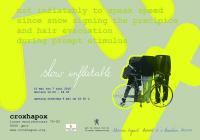
496. SLOW INFLATABLE. Honoré d'O, Karolien Hamers, Thomas Bogaert. 2015.
x
580. FOOD MATTERS. Host: Griet Van de Velde. Guest : Hans Verhaegen. 2018.
een jager en de mussen
1996. OPEN DEUREN [OPEN DOORS], crox 51. 'and moreover, one could let a part of one's home be used by the artists Croxhapox had invited. Among the fifty artists whom Croxhapox had placed are birds of very different plumage. Sometimes the boundaries of the visual arts are crossed, as is the case with Geertrui Daem. She reads from her own work, all be all only on 5 and 6 October, in Nijverheidsstraat nr. 78.' From 'Kunst van deur tot deur', (EB), De Morgen, Friday 27 September.


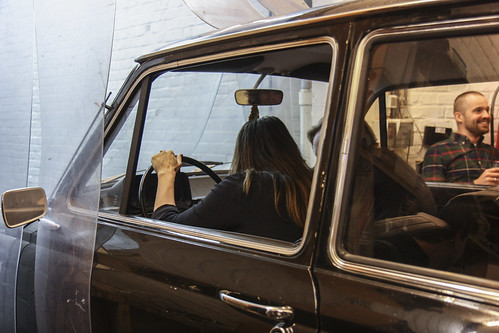
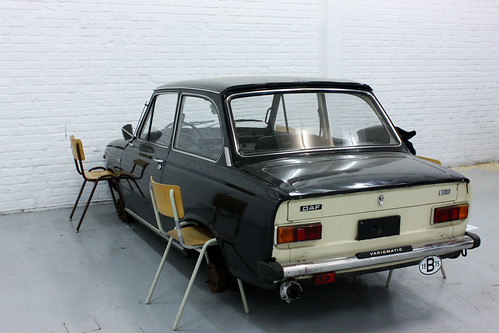
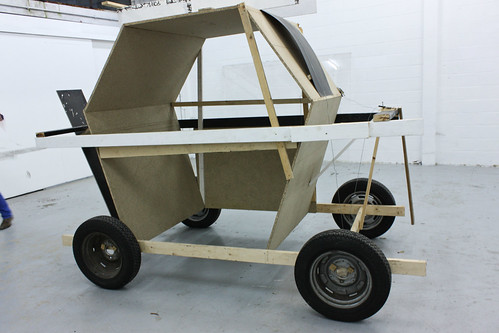
Brainbox#3 (herfst 2013) wordt op gang getrokken door Michaël Borremans, Hannelore Van Dijck en Miet Warlop. Probleempje. Miet, die net als alle andere in het project betrokken Brains maanden eerder toegezegd had, komt laattijdig tot de vaststelling dat ze voor exact zelfde periode nog een project heeft, in Zürich, een theaterproductie, iets waar ze niet onder uit kan. Michaël, kuch, merkt op dat hij in Leipzig verwacht wordt voor een borrel met Rauch. Ik bevind me in Avignon nadat ik van Saint-Nazaire de loop van de Loire stroomopwaarts volgend in Sainte-Eulalie beland was, vlak bij de bron van de Loire. In Avignon logeer ik in een negentiendeeuws hotel. Op het kamertje mag niet gerookt worden. Eén week later alle hens aan dek. Reeds tijdens de eerste werkvergadering bedenkt Michaël dat hij bij hem thuis nog dat ouwe karretje staan heeft, een DAF bouwjaar 1974, aangekocht door Hot Couture voor een promofilmpje. 1974 is het laatste bouwjaar van het ooit roemruchte karretje. Eerst hadden ze er eentje in Groningen gevonden voor het zachtgekookte prijsje van 1.500 euro. Om een DAF veilig te kunnen besturen hoor je over een daf-certificaat te beschikken, het zogeheten Dementie A-Plus Formulier, zonder is het besturen van een DAF een duivelse klus. Dus besluiten ze om uit te kijken naar een modelletje dichter bij huis en vinden er eentje dichter bij huis, in Antwerpen, voor het ingekookte prijsje van 2.000 baf. Hot Couture stemt er mee in dat het karretje bouwjaar 1974 voor de symbolische aankoopsom van 1 euro aan Brainbox#3 overgedragen wordt. Michaël klaart de klus, rijdt met het karretje van Wittemolenstraat 111, waar het geparkeerd stond, naar Lucas Munichstraat 76/82.
Foto 1: Hannelore en Miet en The Brainbox Beast. Foto 2: Michaël legt uit dat je met dit karretje makkelijk Marseille haalt, als je je er tijd voor neemt tenminste, zo goed is het geconserveerd. De motor is een juweeltje. Foto 3: Miet aan het stuur van The Brainbox Beast tijdens wat uiteindelijk de laatste rit van het autootje werd.
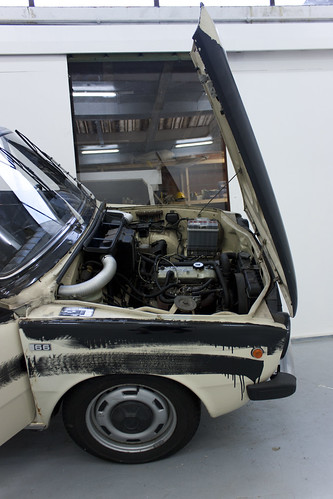


De tweede groep, Steffie Van Cauter, Peter Van Hecke en Jesse Cremers, komt niet tot een gezamenlijk uitgangspunt. Foto 1: na slopend de koppen bijeen gehad te hebben, lang voor de eerste groep met het karretje op de proppen gekomen was, besluiten Peter en Jesse om de motor van het karretje een grondige beurt te geven. Cremers, thuis in de materie, heeft wel zin in het Jongens & Wetenschap speurwerk naar iets met de motor. Foto 2 & 3: Peter en Jesse bouwen het karretje om tot een printer. Foto 4: Steffie, die met het autootje liever een tochtje naar Zeeland, Cornwall of Normandië gedaan had, met z'n drieën, om pas tijdens de openingsavond van groep twee weer in croxhapox te belanden met het reisverslag, distantieert zich van het Jongens & Wetenschapgedoe. Ze neemt een song op waarvoor ze als instrumentatie alleen gebruikt de geluiden die het karretje voortbrengen kan en brengt de songlines op een van de muren aan. Het autootje krijgt het ongemakkelijke gewicht van een met vet en smeersel ingedikte, onbruikbare zakdoek.
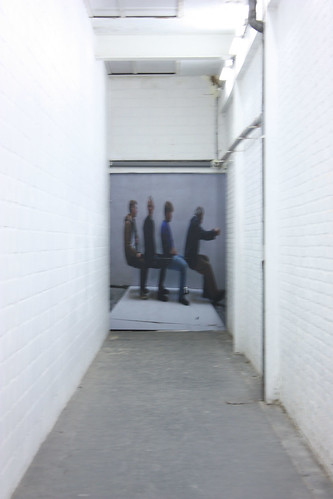
Groep drie wordt vertegenwoordigd door de narren van drie monumentale mogendheden: Frank & Robbert en Robbert & Frank van Bruce Oxlands, Benjamin Verdonck van Het OsOsTheater en Dirk Zoete van het Oink Oink Oink Archipel. Een hectische week. Het karretje ondergaat een tweede transformatie. De leden van de stoet van plotse vrolijkheden rijden naar het ingebeelde Ultima Thule. Een draderig verlangen van stof, Sehnsucht atomisch.
Nadat de vierde groep zich onvoorwaardelijk van het project gedistantieerd had en bovendien ook nadrukkelijk verzocht om de ingreep niet te documenteren,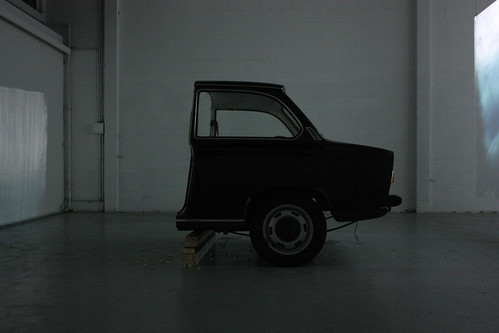

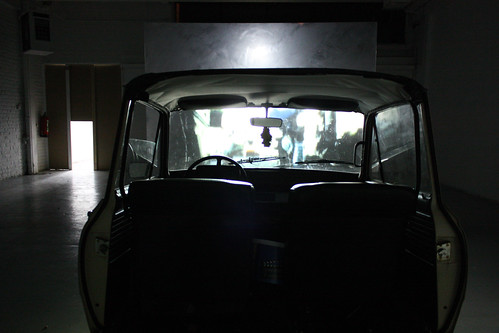
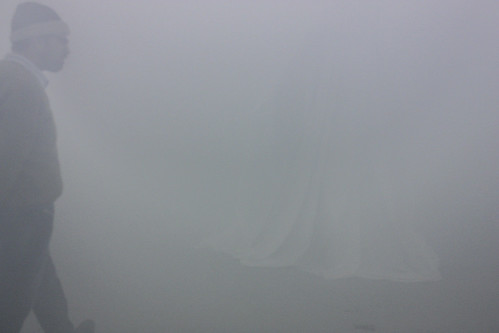
zorgt vijf voor een nog definitievere ingreep. Jasper Rigole, Oshin Albrecht en Inkeri Harri brengen een handlanger in die het karretje in twee stukken zaagt en tunen het project met het pre-Nouvelle Vague van Alfred Hitchcock. Het in twee gesneden karretje wordt een plek om vanuit de cockpit of het achtereind naar het zich tussen beide helften bevindende scherm te kijken met de historie van zomaar een vluchtige uitstap in de Zwitserse Alpen. Met de DAF bouwjaar 1974 is het afgelopen. Tenzij je in de cockpit alsnog Wetteren haalt en het achtereind in Oostakker eindigt. In de volgende fases komt het fabrikaat op een inhoudelijk niveau, waarbij eerst het project zelf ingemetseld wordt en meteen daarop alles in een dikke mist belandt. De restanten van het karretje zijn in ijsschotsen veranderd. Blatend en ijlend dwalen schimmen. Het spektakel is herleid tot nul.

Term uit de beginperiode van Croxhapox vzw die alleen voorkomt in de vroegste versie van de statuten. Het dagelijks bestuur is op dat moment Frank Van den Eeckhout en Hans van Heirseele. Later, van 1994 tot 1999, is het Hans van Heirseele en Kristel De Buck. Hoe het er van oktober 1999 tot eind 2000 aan toegaat, is niet helemaal duidelijk. In de nieuwe statuten, gedeponeerd in 2006, komt de term niet langer voor.
2005-2007: Hans van Heirseele, Joris Van der Borght.
Herfst 2007: Frank Van den Eeckhout, Hans van Heirseele.
2008-2009: Hans van Heirseele.
2010-2011: Laura van, Marc Coene, Stefaan Van Ryssen.
2012-2016: Laura van, Joris Van der Borght, Jelle Clarisse.
2017: Laura van, Mathias Berner.
2018 [ ]: Samira El Khadraoui, Anyuta Wiazemski, Brecht Vissers.
> Und
Author of 'En Passant', one of the texts included in the catalogue of crox 18, En Passant 25 installation windows. The other text is by Hugo De Boom.
In 1913 a painter, and not a minor one at that, introduced his exhibition in this way: 'Because it is bound to the body, the soul is touched by the senses - the experience. Whatever is felt is also a bridge between the material and the immaterial. And it is a bridge between the immaterial and the material. So each work of art has two sides: the inner and the outer side.'
So have all introductions: knit one, purl one.
Another Russian, in the same year:
'The representation of an object - objectivity as goal of representation - is of no matter to art. Though the fact of representing anything doesn't exclude the artwork being of the highest order.'
These statements are surely worth of careful consideration and testify to an uncommon insight in the fragile proces of communication between the artist, his medium and the public even though it isn't quite this kind of communication which is aimed at in this exhibition.
In search of the right type of communication one should rather start from the following proposition: During a surge of diligence, the marketing department at Popla's has figured out that a person spends a year and a half on the toilet during a lifetime.
This was used as an argument to promote better toilet paper.
A year and a half, it takes a better man to ignore it.
In the same vain, a person spends about eight yeas out in the street. And only modest paths have been followed to make life moe agreeable for him in that respect: broader pavements left and right, dogs refraining from dropping it on the cobbles and a sudden shop window worthy of being glanced into.
Among other needs, this is what this initiative is catering for.
In Schepenhuisstraat, an alley between Hoogpoort and Onderstraat, at number 33 as I recall, one of the first installation windows was created. (Later on, a second one was to be found in Perkamentstraat - it is still there - but we are only concerned about the first one here.)
One day, seven or eight years ago, a fifty-ish woman walked down the street to Onderstraat, and so she passed that spot. In her left hand she was carrying a Big Shopper bag, and in her right she had a bicycle wheel. She glanced to the left into the window where a large number of elephants were arragend in military fashion. Her pace slowed and she thought: 'tiens'. A hesitant sun illuminated the spot where a four star hotel would soon be built. It glittered in the puddles. The ladu blinked, in two minds whether to stand still and follow her impulse to watch what had caught her eye.
It happened: the window took her over. She switched the Big Shopper from left to right and leaned on the bicycle wheel. Her eyes grew bigger and her facial muscles distracted, a quarter of a smile appeared.
So that's it, erm, that's it entirely. Though the fact of representing anything doesn't exclude the artwork being of the highest order.
Footnotes:
Wassili Kandinsky, as cited by H. Read, 'Der Sturm', 11 Aug. 1913. Read has the pluck to comment on this with: 'a clear though somewhat clumsy definition.'
Kasimir Malevich, 'Suprematisme', 1913.
Michael Ogilvy, Essay about marketing, no title, 1990.
THE MEDIUM, monodrama for mezzo. Project by Els Mondelaers. March 2007, crox 204.
2006. Basics 2, sequel. Groepsproject in Abdij Maagdedale. Aan het project nemen 90 kunstenaars deel. DD Trans presenteert een ongeschonden schetsboek en levert er ook een potlood bij.
2007. crox 277, Frans-Belgisch groepsproject. Dit keer presenteert DD Trans een klimplant - die zich aan een lampadair heeft vastgehecht - en een wolkenfoto. Met de wolk zit het dubbel: op de voorgrond is een naakte hand, de rechterhand van DD Trans. Tussen wijs- en middelvinger steekt een sigaret.
Van de Frans-Belgische groep zijn Bart Vandevijvere, Brahim Bachiri en DD Trans de enigen die geen instalraam realiseren op de gebruikelijke locatie, Onderstraat 26.
One of 17 people who sent in a contribution for the KNUTS project (1992). The project was aborted because of far too few and far too little interesting contributions.
see KNUTS
Herzamelen, 29 april - 1 mei 2016. >Vanhille, Emma
a/ one ring found, transported, restored and placed (2016) corridor
b/ five rings found, transported, restored and placed (2016) backspace
Author of Steps, Paces, Looking [Stappen, Passen, Kijken], the second preface to the En Passant catalogue (1991):
(fragments of a myth)
I.
Urbanisation leads to a neutralised, homgenised space, and each activity within its reification -the city- is through the usage of specific codes assigned a particular time-space.
In time as much as in space, ghetto's get built - mutatis mutandis. The city is nothing but a concatenation of islets (living space, workfloor, playground, cemetary), whoever enters an isle is assigned a function. (Crossing the shop threshold turns one into a customer).
II.
The ghetto of the shop windows: concentrated in space and perimetered by parallel streets where the only colour comes from window shutters and wall cancer.
A remarkable updraught of shopping centers, all but alien to man and still suggesting the differentiating signs and symbols. Demonstrating lifestyle. Ornament and concealment.
III.
The city itself, according to Baudrillard, is no longer a production unit but a wildly complex conglomerate of code systems, complementary, contradictory and mutually interacting.
A polygon of sigsn, media, codes. A muddle, a mess, a clutter.
Solely on such a constellation -when real production in the city is replaced by media leading to the assimilation of signs- a project like 'En Passant' is possible and meaningful.
The same goes for a previous project where posters where distributed round the city. (Copy Art Project)
A specific space (and Croxhapox doesn't have one) for art is not necessary, the street can take the role of museum. Ephemere, but no less conspicuous.
Walter Benjamin already saw that through the levelling influence of the city its aura gets lost. I.e. the authentic communication between the subject of the gaze and the object looked at doesn't exist anymore.
Art still has the connotation to promote this interrelation; to blow away the fumes and to lay bare the essence of things (le parti pris des choses), without paper constructs.
Fortunately, 'En Passant' isn't so presumptious.
crox 70: Schilderkunst Hedendaags Belgisch (1997). One out of 25 artists participating in this project.
crox 110, BASICS 1 (2003). Drawings, sketches, studies. Mario De Brabandere contributes three pencil drawings made during his Campo Santo project in 1996.
crox 175-III: la mère de dieu fait par le fils lui-même; solo project in the media space (May-June 2006 [The mother of god made by the son, himself]). Sculpture assembled with object trouvé materials; height approx. 240cm; anchored into the wall immediately opposite the entrance to the media space. The sculpture is reminiscent of the pastoral figures in the later work of Kasimir Malevich.
crox 145-II, BASICS 2 (2006, sequel Abbey Maagdendale). MDB contributes 3 objects in, one is a wooden crate with the collection of Martha De Brabandere, Mario's dog.
Participating in Five Collaborations, the project of Alan Smith (January 2007).
Text by Hans van Heirseele, published in a catalogue of the Centre for Culture of St. Amandsberg. (1997), on Mario De Brabandere: MARIO DE BRABANDERE is one of those painters Georges Perros is talking about in Papiers Collés./ He is a genuine painter. He certainly is one of those who don't get bored when painting./ I recently met Mario in the greens market./ A Sunday, one of those Sundays, when danger hides round each corner. Suddenly and before we even noticed boredom kicks in. Mario hadn't recognised me. I walked towards him. He wanted to leg it but I caught up with him. I grabbed him in the collar of his overalls and lifted him a few centimeters off the ground. This is definitely a good way to make sure to have a good conversation with someone. / Hey! Well! Mario, of all people! I shouted./ What what, he cursed./ Glad to bump into you! I shouted again and gave our celebrated friend a shove so his casket rolled on the cobbles all the way to the closest bus stop. Verily, one has to know how to deal with those painters of ours. Listen carefully, buddy! I shouted. I'm gonna tell you something, listen! I shouted again, and hit'im square in the gob. Come on, out with it, tell me, do you ever get bored eh? well, hey, you know, you can tell me!/ Hans, man, I really never get bored, hardly ever, sure, he said./ And if you would let go of me now, I'll tell you how that is./ God, just as well, it had been nice. I let go of him. Usually I don't. I'm not easily intimidated. But it happens. / You see, Hans, he said, when I get bored, on occasion, I try to make the best of it. You see, Hans, sometimes those are the great times./ And then he sold me./ Jesusmaryjoseph, I'm still not back on my feet again. (October 1997)
-->Zondagsdenkers, De
En Passant, made for Terzake, an art programme of BRT (1991). Camera man is the father of Jan De Cock, with whom Guido has often collaborated.
Look, thought the founders of Croxhapox (a galery without galery, because of the blue stone of course): if the mountain doesn't come to Samson, Samson goes to the mountain. A truly edifying thought: let a number of x artists make >installations in shop windows. The spontaneous watching reflex of the common man will kick in and do the rest. A little bit of contemporary art is always welcome. En passant. “You just have to think of it, isn't it sir."
crox 380 (2011). Project in de kubusruimte.
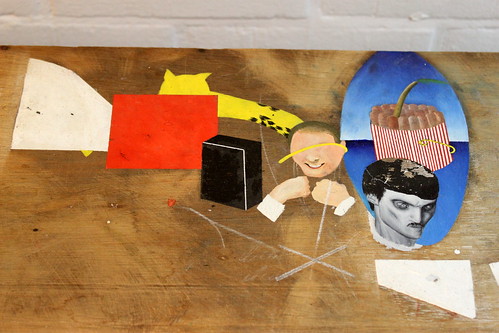
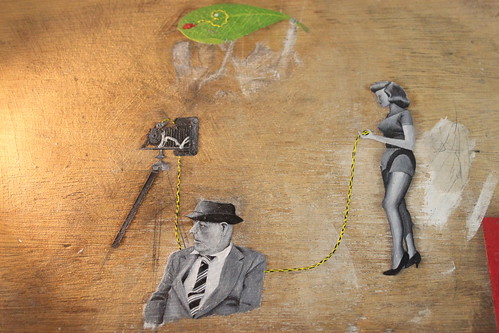
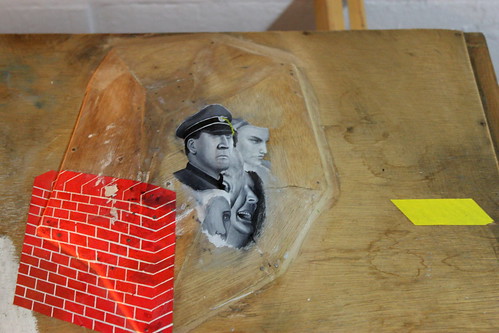
foto's: MC
crox 412 (2012). Max Pinckers en Quinten De Bruyn. LOTUS. Maakt deel uit van Between The Lines, een project over 3gender met presentaties van Tiane Doan Na Champassak, Marc De Clercq en Max Pinckers en Quinten De Bruyn die foto's van katoj, eerder getoond in Amsterdam en Brugge, combineren met kiekjes die katoj van zichzelf maakten, een film en een nagebouwde slaapkamer, zoals je die in Thaïland vindt.

foto's: laura van. Links en midden: Quinten tijdens het bouwen van de slaapkamer. Rechts: foto die als ik het goed heb in Vrij Nederland gepubliceerd werd, n.a.v. de expo in Amsterdam.
crox 456 (2013). Project in de kubusruimte.

foto: cristina amelia
> od3
crox 51 (Open Deuren/photos), Autumn 1996. Eric Bracke, De Morgen 27 September 1996: *We print one of the works of Marc De Clercq allongside this article. The photographer registered the spontaneous behaviour in the inner circle of a family in the Wolterslaan. His life-sized pictures will be presented there at number 101 during Open Deuren. De Clercq counts on the special tension between the images and the particular, exceptional behaviour of Caroline, Seger and Marie when they are host to unknown visitors.
crox 78 (1998). Photo project with Frederik Cornelis and Anja Hellebaut. Marc produces some four B/W picture cards, among which one with a work by Frederik and one by Anja.
crox 188, Brainbox (2006). Track 2. MDC produces a portrait photo from each artist participating in the project. He uses a technical camera. From unit 3 he starts documenting the project itself.
Joins the General assembly in 2007 and gets elected a member of the Board some months afterwards, together with lknur Cegniz and Marc Coene. Member from the board from 2007 to 2012.
Early April 2007 publication of crox cards 51 and 52 documenting the 6th Brainbox unit.
crox 411 (2012), a project on 3gender photography & film. Between the Lines. Triptych with Tiane Doan Na Champassak, Max Pinckers/Quinten De Bruyn and Hijra's, Indian 3d Gender, Man nor Woman, MDC's part of the project, shown in the backspace. A dance performance of Laura Neyskens during the opening night. Coproduction Tra Mundi/croxhapox, supported by Stad Gent and Cavaria.
left to right: Marc De Clercq, Max Pinckers/Quinten De Bruyn, Tiane Doan Na Champassak (flyer produced by MDC)
crox 76. Introduction with a very sad pre-installation. [Inleiding met een treurige vooropstelling]. April 1998
crox-card 14: The Industry of Human Happiness. [De Nijverheid van het Menselijke Geluk] 1999
crox 102. Carte Blanche. Crox-project on location: CC Strombeek-Bever. A tryptich: Anton Cotteleer, Dirk Zoete and Jan De Cock. Februari 2000 >Byll
2007. crox 216. Photos. First project of Liesbeth De Fossé (BE) who lives in Paris. One before last project of what was, at that point in time, the 'second' croxhapox (crox2), a space close to the atelier of Stief Desmet. LDF moves the wall which almost reachs to the ceiling previously built by Dirk Zoete. The wall is placed diagonally in the room and creates a conical entrance at the back where she presents a series of pictures made in Boston. A series of large semi-panoramic pictures fill the room properly. Crox-card nr 60 (2007): Fig. 0603002.
[De Gentenaar is the local Ghent edition of a Dutch speaking newspaper (de Standaard)]
crox 11 Daniël Libens > December 1990/ review Dirk >Pültau
crox 13 Sjoerd Paridaen > February 1991/ Dirk >Pültau
crox 18 En Passant > Autumn 1991/ review Dirk >Pültau
crox 24 Edwin Carels > January 1995/ Dirk >Pültau
crox 27 Hans van Heirseele > May 1995/ Dirk >Pültau
crox 30 Maria Blondeel (installation window) > October 1995
crox 51 Open Deuren > September 1996
crox 51 Open Deuren > October 1996
crox 177 Macharius project > May 2006
crox 4, solo project - nothing (April 1990).
crox 18, En Passant - location 2, Sint-Pietersnieuwstraat 84 (September 1991).
crox 51, Open Deuren (1996).
Installation window May 2006, location Onderstraat 26.
The first contribution of Hugo De Leener (crox 4, mei 1990) comes to nothing. Frank and Hans document this nothing, even something which is nothing needs to be documented. There is indeed a video of crox 4.
For his second solo project and his participation in group projects like En Passant and Open Deuren he contributes practically identical work. There are internal variations within the works.
flyer
Stage tijdens Master grafische vormgeving Kask, voorjaar 2012. Layout van flyers, adds en twee reeksen crox-cards. Aanzet tot het ontwerp van de crox-pursuit speeldoos.
crox 58, solo project - January 1997.
crox 70, Schilderkunst Hedendaags Belgisch - November 1997.
Crox 58 happens just a few weeks after the first visit of KDM to croxhapox, at that time in Aannemersstraat. He's at the top of the category 'at short notice' where he is preceded only by Tim Onderbeke (2006) and the duo Smith-Buckland (2005).
For his solo project Karel makes a series of black paintings, acrylic on plastic, showing white signs.
>sacro cranio
Crox 400-2, Stoelendans. 5 - 10 maart 2012. Een improvisatieweek van 3de bachelor Beeldhouwkunst KASK.
crox 434, januari-februari 2013. >Witte Raaf, de. Solo presentatie met Study, test block, test shelve, test room (2011, work in progress) en 12poot (2012).
In de andere zaalhelft een presentatie van Eric Pries.
crox 434, januari-februari 2013. '12poot', een 12 minuten durende video en 'Study, test block, test shelve, test room', een plankje met objecten.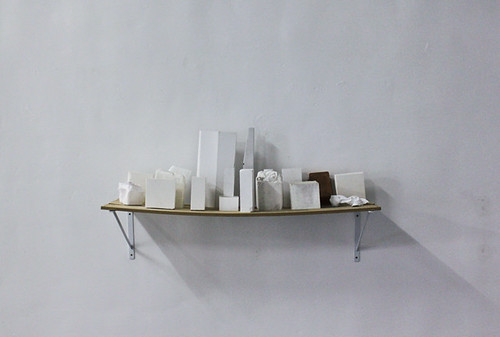
K.B./D.P.: Je vertelde ons in november dat je aan een groepstentoonstelling in de galerie El te Welle deelnam en dat je door de Gentse ruimte Croxhapox was uitgenodigd om je film 12poot te tonen...
A.D.M.: Zoals jullie wellicht gemerkt hebben, ben ik op de uitnodiging van Croxhapox ingegaan. (De Witte Raaf nr. 162, maart-april 2013)
22. Herr Seele. Eric Bracke, October 1994.
36+37. Niblock-Brand-Devens. Luk Lambrecht, January 1996.
51. Open Doors [Open deuren. Eric Bracke, September 1996.
70. Painting Contemporary Belgian [Schilderkunst hedendaags Belgisch. Luk Lambrecht, November 1997.
Yearly overview 1997. Luk Lambrecht, January 1998.
Herr Seele in croxhapox-format. LVDS, January 1999.
94+95. Wendy Hirschberg, Lieve D'hondt. Luk Lambrecht, 1999.
96. Philippe Vandenberg, Sylvain Cosijns. Christine Vuegen, May 1999.
96. Philippe Vandenberg, Sylvain Cosijns. Eric Bracke, May 1999.
In the new millenium De Morgen [one of two Dutch language Belgian ‘quality’ newspapers] apparently is interested only in mainstream and museum projects. Organisations such as Voorkamer or Croxhapox no longer seem to be worthwhile. Ironically, in the mid nineties projects by Borremans and De Cock weren’t even reviewed; De Cock and Borremans weren’t sufficiently famous. De Morgen wasn’t interested. Nowadays, if one calls the culture desk, they even haven’t heard of Croxhapox. Logical, De Morgen is by now nothing more or even less than the semi-intellectual equivalent of Het Nieuwsblad [Dutch language Belgian tabloid].
HERR SEELE IN CROXHAPOX-FORMAT - LVDS (Metro, weekly magazine of De Morgen), 27 January 1999. I arrive when no one in their right mind would even consider visiting a gallery. Eventually, the door is open, as it probably is all day. From the back of the back kitchen comes the voice of someone who apparently is taking a late quick breakfast. Pleased to meet you. The person I greet is the spit image of Herr Seele. You couldn’t have expected otherwise.
14 november 2016. Sofie Van Hyfte. An article on the auction of December 17th, 2016. > auction
crox 26, solo project - March 1995. Photos.
crox 48, installation window (Onderstraat 26) - June 1996.
crox 51, Open Deuren - Autumn 1996.
Introduces Patricia Smith (US) and Antje Dorn (D). Both have solo projects in 1995. Via the first one, a.o. Thomas Broadbent comes to Belgium, in 1996, via the second, Thomas Hauser (1997), Gosbert Adler (1996), Thomas Böing (1999-2006) a,d Stu Mead (2004).
DDN takes care of the ectachromes of the works in the second and third series of crox cards (1998-1999).
>Urk Piw - opening speech of crox 26
Performance op zaterdag 16 oktober 2010. Openingsavond. Na de performance van Didi de Paris een intense set van Merlyn Paridaen (d) en Zeger Vandenbussche (s).
Didi de Paris had begin jaren negentig met Braindrain een van de eerste digitale magazines.
Aymeric de Patol, geluidstechnicus. Werkt vaak samen met Yannick Franck (Idiosyncratics). Tijdens zomer 2011 en zomer 2011 gebruiken ze de zaal voorin als opnamestudio.
vendredi 12/08/11 (fragment)
Aymeric assis dans le mediaroom devant un STUDER années soixantes. Inscrit sur son visage les mots silence, pas de bruit, ne faire aucun brut.
LES CLOCHES SONNENT. Yannick, paysagiste dans des courants de sons vastes, sonores, obscures. Un paysage déformé, troublant, un vide énorme comme dans le désert, sans repos, extase du vide.
Le Studer, zegt Aymeric, - 'oup'..., de opname is net afgelopen, '... c'est vraiment le top, un son magnifique.'
'C'est bien dans la boîte?' lui demande Yannick.
'Ce'st très bien dans le boîte, très granulé.' Ils y avaient toutes sortes de sonorités. Her en der staan microfoons opgesteld. Een bladzijde omdraaien in het notitieboekje: quelle merde de bruit épouvantable - dan het nagelvijltje bovenhalen, très très doucement...
1991, En Passant 25 installation windows. Location 15: Trommelstraat 4. One of the shop windows of Double Face, a clothing shop. On the left hand page in the catalogue, there is a handwritten reference to what probably is the title of the presentation: INABSTRACTO.
crox 51, Open Doors - Autumn 1996. Venue 92. Paintings.
crox 70, Schilderkunst Hedendaags Belgisch - 1997.
Publication of croxcard NR 18 (1999). Acryl on canvas, untitled.
crox 194, WELD - November-December 2006.
WELD is the artist's collective of Jan Wiels & Vincent de Roder. The WELD-project in crox2, during the finale of the first edition of BRAINBOX in crox3, is the first collaboration of both artists. Starting point is the space itself: a surface of 10,5 by 11m, the high walls, the single buttress and the mdf-wall separating crox2 from the atelier of Stief Desmet. WELD works in a carefully considered and transparant manner even though they thank a lot of the objects which end up in the project to serendipity or coincidence. Copers' swimming pool e.g., or the forms of leftover building materials which are reused as a module.
>Wiels
crox 18, En Passant (1991). Location 16, Sluizeken 29, milliner Sjapoo.
crox 198, Schervenluster (2007). Solo project in the cube.
crox 494, GOLVEN, een performance van Toine Horvers. Vijfstemmige uitvoering, donderdag 23 april 2015. Johan is een van de stemmen.
de partituur van Golven in het handschrift van Johan De Rycke
2011. crox 368, residentie. De residentie, waarbij JDR zich toelegt op een presentatie van grafisch werk en foto's en experimenteert met alternatieve presentatiemogelijkheden, valt samen met projecten van Sjoerd van Leeuwen (NL), Simon Van Parys en Johanna Van Overmeir.
2007: presentatie van afstudeerproject (3D, KASK). Na een crisisperiode besluit Rob om al het werk dat hij tijdens zijn studie aan het Kask heeft gemaakt wit te schilderen. Tijdens de nacht van 22 op 23 juni 2007 overnacht hij in de kubusruimte. Een belangrijk deel van de werken komt aan de muren van de kleine kubusruimte terecht, de rest wordt gedumpt. Hij schrijft een afscheidsbrief. De brief komt op een kleine, zwarte tafel terecht. Tijdens de vernissage (zaterdag 24 juni, 18u) blijft Rob wachten tot zijn promotor, Frank Vande Veire, opdaagt. Daarna gaat hij ervandoor.
'Als je het zo bekijkt, is het toch weinig. Het is niet al mijn werk dat ik op heb gehangen, maar toch het voornaamste deel. De dingen die ik niet opgaf voor ik eraan begon. Ben ik lui geweest? Nee, maar ik ben misschien wel laf geweest. Steeds opnieuw werd ik bang wanneer ik te lang op één spoor zat. Was het eindstation wel waar ik wilde zijn? Bij gebrek aan een antwoord werd het pas ter wereld gekomen idee laattijdig geaborteerd. Het rariteitenkabinet. Een stoffige, kleine, mysterieuze kamer. Een tentoonstelling van gedrochtelijke foetussen.
Het is mistig in mijn cel. Met een weinig moeite bereiken de foto's, schilderijen mijn oog. De zonden die ik aan deze vier woorden heb toevertrouwd lijken zacht te glimlachen. Even bekruipt me de angst dat mijn daad slechts een poging zal blijven. Ik probeer een volgende laag aan te brengen, ik veeg enkel de vorige laag weg. Ik zal geduld moeten oefenen. Laat ik de tijd even nemen om kort verslag te schrijven.
Langzaam raakt alles ondergesneeuwd. Het wordt kouder. Ik kijk naar mijn zelfportret. De echo kijkt mij van zijn kant - verwijtend? berustend? - aan. Ik weet niet of de echo enkel in miojn hoofd nog bestaat, of er werkelik nog iets rest. Ik ben ondertussen de tel kwijt geraakt. Ben ik aan een derden vierde, vijfde laag? Mijn geest raakt ook ondergesneeuwd. De volgende laag heeft geduld. De vologende laag zal de laag zijn. Dan zal alles wit zijn. Ik moet slapen.
Hoewel hij zichzelf al een hele tijd aankondigde, komt het toch onverwacht. Opluchting. Om een dramatischer woord te gebruiken: KATHARSIS.
Dit is mijn afscheid, mijn laatste woord. Rondom mij hebben mijn werken me in witte vrede verlaten. Na uren wachten, laag na laag, is alles weg. Geen echo blijft nog over, enkel mijn zelfportret heeft weerstand geboden. Ik wil het hem wel gunnen. Toen was ik nog naïef romantisch. De dezen wil ik graag ontzien, ze weten nog niet beter. Misschien kan je de wereld wel verbeteren, maar eerst moet je hem (haar) aanvaarden. En toch proberen te kennen. En kan kunst de wereld redden. Ik heb enkel mezelf willen redden. De werken, documentatie van mijn kunst probeerden enkel mij te redden. Het bewustzijn hiervan kwam later. Dat bewustzijn was vernietigend. Al mijn werk, mijn daden, mijn doorgaanse denken werd erdoor gedeconstrueerd. Het bewustzijn verbrijzelt mijn identiteit. Ook die identiteit is een constructie, een kunstwerk of liever: gekunsteld.
Ik ben te jong,
ik ben te oud om kunst te maken.
Mijn bewustzijn scherpt. Scherp genoeg ondertussen om al het voorgaande te dissecteren. Scherp genoeg om bewust te zijn van zijn botheid. Daarom moet er katharsis zijn. De pijn is kort en herbergt een grote beloning. Vrij zijn, niet van de omgeving, maar vrij zijn van 'mezelf'. Hoe minder er rest van mijn identiteit, hoe scherper mijn bewustzijn, hoe meer ik, ik ben. En dat ik is een zalig niets. Vermoedelijk. Mocht er dan toch iets resten - Griekse passies? - dan kan ik pas kunst maken. Maar enkel dan, na de aanvaarding. Het absolute individuele bewustzijn. Van daaruit vertrekt het echte leven, het opprechte zijn. Dat is mijn bestemming.
Dan pas wil ik kunst maken.
Dan pas kan ik kunst maken
en dan zal ik kunst maken.'
Treedt eind 2007 toe tot het crox-team. Specifieke taak: layout. Een van de eerste karweitjes is uitvoeren van het crox-boek van Philippe Vandenberg, Black A Garden For Saint-John's Millbrook (crox-boek nr 8). De publicatieformat is beperkt tot zwart-wit en één steunkleur. Van de tekeningen die Philippe in het boek wil, zijn er best veel die hiervan afwijken zodat uiteindelijk geopteerd wordt voor zwart-wit en twee steunkleuren. In nauwe samenwerking met Philippe Vandenberg en Johan De Wilde transformeert Rob de kleurtekeningen naar zwart-wit/twee steunkleuren, een hels karwei, millimeterwerk. In 2008 volgt nog een boek, dat van Brian Getnick en Noe Kidder, The Gentlemen's Gentlemen (crox-boek nr 9), in 2010 Ge staat daar op het kerkhof van Aalst bij het graf van Louis Paul Boon (crox-boek nr 12), het Boonboek van Guido De Bruyn, in 2010 het boekproject van Hans Beckers, Sonare Motus (crox-boek nr 15). Rob zorgt ook voor de layout van tafelonderlegger 1 en 2 (2008) en een reeks crox-cards.
Lid van de Algemene Ledenvergadering van eind 2007 tot herfst 2011.
crox 38, solo project - February 1996. Drawings.
Several tens of sketch books and drawings grouped thematically, stuck to the wall with the iron ring mechanisms of ordners. HDS regularly produces carefully edited publications from these works, privately. Two of these editions, one of them a carbon booklet, are in the crox-archive.
1996. crox 51, Open Deuren. Een locatie in de Wolterslaan. In de garage van het huis waar ze woont, presenteert Theresa De Smet tekeningen en schilderijen. Op zondag 6 oktober 1996 is er een concert, om 5 uur 's avonds. Driestemmige gezangen met Martine Huvenne, Chris Decraemer en Theresa De Smet.
Theresa is een van de vele kunstenaars die op dat moment in de Aannemersstraatbuurt wonen: Guy Vandeplassche, Alexandra Jacquet, Sjoerd Paridaen, Patrick Verlaak, Katrien Perquy, Beatrijs Lauwaert, Geertrui Daem, Martin Fryns, Joris Vermassen en Frank Clarysse en Els Dedecker. Ook Michaël Borremans woont vlakbij.
crox 77 Dianna Frid > April 1998/ review Edith >Doove
crox 79+80 Ignace De Vos, Dirk Peers > June 1998/ >Doove
crox 82+83 H. Nickisch, H. Schwarz > Sept 1998/ >Doove
crox 86+87 Thomas Huyghe, Z. Devens > Dec 1998/ >Doove
crox 88+89 A. Cotteleer, P. Thornley > Jan 1999/ >Doove
crox 92+93 Marc Maet, M. Borremans > March 1999/ >Doove
crox 97+98 Larry Krone, J. De Wilde > June 1999/ >Doove
Sirenes 5 October 2006
2009. crox 315, a project by Michel Couturier. Michel builds a wall in plaster in the main room, frontal to the front entrance. Michel wants to drive a car through the wall. Enters van Swaef. He owns a black Citroën DS. At first they wanted to use another car, also a Citroen DS, somewhere in a garage, but they can't get the engine going. Monday 5 October 2009, that's when it happens.
crox-box 5 October 2009
Bertoni The Citroën DS, a revolutionary design by Bertoni, is Italian
design. The first model, mid fifties, had round head lights.
Bertoni also designed the Citroën SM - only a few thousands of them were ever brought to market.
Citroën
Sven De Swaef promised to drive a Citroen DS through the plaster wall. Not his own - he had contacted someone who swore high and low he had a functioning Citroen DS, meaning, till this morning. The story, and the car, didn't work. Some replacement parts were missing. Sven decided to use his own. He knows his beloved car inside out. He repairs it himself. What could go wrong? Anything. He called some guy who had spare parts, calculated a maximum loss of 300 euro's, at least if the plaster wall didn't crash entirely.
'Tu te rends compte, c'est sa voiture...' A black Citroën DS 21,
year 1973. It was last produced in 1975. They stopped assembling in 1975. How did he feel realising there was no other option than using his own DS? Sven admits, it's not a nice feeling. He's gone through a lot with that old beasty. The engine, it is a masterpiece. To reduce the possible damage to the Citroën DS 21 they decided they would drive at 5 km. Michel commissioned three students and made sure they were insured till their toe nails.
Nina,Gauthier, Julien, studying photography. Marc is present. Sven has no misgivings. The only thing that bothers him is when the wall would fall on the DS. That is the least interesting scenario.
2010. crox 340, HZTM Sharper Gets Sharper. Performance at Friday 1 and Sunday 3 October 2010.
> od3
crox 359 (2011). Colette Dubois over Harri de Ville (H-art 77, februari 2011): 'En 2005, les deux artistes Sabrina Harri (°1979, Finlande) et Alexia de Ville de Goyet (°1982, Belgique) se sont rencontrées à Helsinki. Depuis ce moment, parallèlement à leur pratique personelle, elles développent un travail commun sous le patronyme Harri de Ville qui apparaît ainsi comme un troisième personage. Le travail d'Harri de Ville s'est d'abord centré sur la performance vidéo avant de se prendre la forme d'installations qui ouvrent au spectateur un espace dans lequel il peut se projeter.' Colette helpt ons aardig op weg. Ze hebben elkaar in Helsinki ontmoet, het derde personage is un patronyme (staat niet in het door Wolters Plantyn uitgegeven Lexicon van literaire termen, althans niet in de zevende, herziene druk) en ze hielden zich aanvankelijk vooral met het maken van videofilms bezig. Wat we niet te weten komen is op welke manier ze elkaar ontmoet hebben. Zaten ze naast elkaar in een autobus? Was Sabrina oudjes aan het voederen en vond Alexia dat zo grappig dat ze er foto's van begon te maken? Hebben ze elkaar in een galerie ontmoet, tijdens een workshop, op café, in een boekhandel? We komen het niet te weten. Wat we wel te weten komen, is dat ze net voor het crox-project in de Brusselse galerie Jozsa een expo hadden, intitulée 'Les Ombres sont déjà des Murs.' Wat later in de tekst komen we meer weten over 'Spell', een video die ze in de Luikse galerie Flux getoond hadden. Het werk maakt ook deel uit van de enscenering in croxhapox: 'une projection vidéo qui re reflétait dans un miroir de plexiglas noir.' Colette identificeert het werk als volgt: 'L'image nocturne d'un coin de parc de château éclairé de façon cinématographique entrait un contraste avec le son direct du bruit du vent dans les arbres juste avant l'orage. Dans les deux cas,'
Sabrina raconte
Sabrina raconte. Je lui ai demandé, mais c'est ou que t'as rencontrée Alexia. Elle raconte. C'était à Helsinki, comme Colette le disait. Elle venait dormir chez moi. Elle venait dormir chez toi? (augmentation et inclination de la hauteur de ma voix vers la fin de la phrase) Oui.
Elle dit oui. Elle venait dormir chez moi. Elle venait d'arriver assez tard à l'Académie ou commencait son étude Erasmus. La boîte était désolée, presque personne, pas de lumière, c'était en hiver, pire de banlieu à l'est de Helsinki, demi heure de la ville, chambre noire, pas de téléphone, elle ne savait prendre le tramway. Un ami me téléphonait, l'expliquait, fille perdue etcetera. Alors elle venait dormir chez moi. On n'a pas beaucoup parlé. Les Finlandais ça ne parle pas trop. En tout cas, dans ma famille, c'est des solitaires. Aprés on faisait du VJ. VJ c'est souvent pendant des heures. Les deejays ça change, le VJ souvent fait toute la nuit. Elle venait de temps en temps chez moi. Le truc VJ se passait dans des endroits lointains. Ou il y avait des raves. Et voilà, ça se passait comme ça.
Deux. Je lui demande, la location du film, l'image du jardin, c'est quel endroit ça. Elle le dit. Elle ne dit pas tout. C'est des petits morceaux. A Bruxelles. Les environs. L'endroit n'a rien d'autre de plus précise que ça. Une maison, le jardin. Une maison avec une petite folie de grandeur. Elles avaient une résidence au Bains Connective. La date: décembre 2010. Le premier projet de Harri de Ville était en Suisse. Elle le dit. J' avait un projet à Genève, au Grüti, et invitait Alexia à venir à participer avec moi. C'était quand, je lui demande. Elle le dit. Janvier février 2009. C'est les débuts de Harri de Ville. Elle faisait une sculpture video. C'était une volume avec un projection à l'intérieur et une performance en plus, avec Yannick.
Harri de Ville en tout cas a quelque chose de fixe, elle a une caractère. Le projet à Genève était lié à Bildschreitung, un texte de Heiner Müller, Paysage sous surveillance. In het Engels: Explosion of the Memory.
End of de Harri de Ville collaboration in 2012.
zaaltekst crox 359
Harri de Ville is a duo project created by Sabrine Harri and Alexia de Ville de Goyet in 2005. They started to experiment Vjing and video performance. In 2009 their work evolved through sculptures and installations integrating video, defining and interdisciplinary language where abstraction and narrative elements merge. Since then, they have been active in the fields of visual arts and performance. In 2009, they performed at the Grütli theater in Geneva and started exhibiting together as a duo, participating in many exhibitions in Finland. Recently they were residents at the Bains Connective Art laboratorium in Brussels and exhibited at Espace Flux (Liège) and Jozsa Gallery (Brussels).
Sabrine Harri (1979, Finland) studied at the Villa Arson (E.P.I.A.R.) in Nice, France. In 2009 she graduated fromt the ALPES post-diploma at Geneva's University of Art and Design. Alexia de Ville de Goyet (1982, Belgium) studied Fine Arts in Brussels and later at Central Saint Martins in London.
crox 359 Exhibited works
No Fear No Hope, 2011. Lamp, wire, morse coded electronics.
Untitled, 2011. Cellular blocks, plexiglas, floodlight, blue gelatin film.
Untitled, 2011. Broken car glass, spotlights, blue gelatin film.
Spell, 2010. Black plexiglas, video projection, video 14', sound stereo.
2006. Video-portrait, part of a triptique. crox 169, a project by Annelies Slabbynck.
2007, 5 April. crox 208, MA solo. A solo performance in the large room at the back. Emilie had done the performance before and plans to repeat it, in Campo. Dance performance on photocopying machines. By a hair's breadth, we bought the machine.
crox 17-I, Copy Art project (1991).
crox 51, Open Doors (1996).
crox 70, Schilderkunst Hedendaags Belgisch (1997).
crox 79, solo project (1999).
Publication of croxcards Nrs 15 & 16 (1999).
crox 104, the first 10 (2000).
One of the very first visitors, when Croxhapox still resided at Beverhoutplein.
Participates in crox 17 copy art project - his work is the photocopied reproduction of a drawing - and Open Doors (crox 51), with a number of paintings this time. Also present in Schilderkunst Hedendaags Belgisch (crox 70).
A solo follows in 1998 (crox 79), reviewed by Edith Doove (De Standaard, 17 juni 1998): SCHRIFTUUR. Ignace De Vos has fir years been developing a painting signature of his own. In it, aan een bepaal he is reflecting on the American tradition which for him is still meaningful. The paintings he presents in Croxhapox, show De Vos' well known pattern. He places his cloudlike structures on top of eachother in broad horizontal and vertical swathes. The process takes a long time in which De Vos strives for a certain balance. I caught myself feeling the mesmerizing effect of several of his paintings. The strong layering and the surprising shades of colour are an invitation for a more thorough inspection.
Over the years De Vos has been working in a more transparent way. Paint is usually applied in very thin layers, but sometimes he covers his canvases with a solid layer. The original setup remains visible right through it. Two uniform canvases function here as a counterpoint. They have become closed images, making one wonder what is hidden under the pistachio green or black.
for his abstractions, De Vos usually starts from figurative images.
>Doorway Rock
crox 203 (maart 2007). FINDING NEMO. Project in de kubusruimte. Andere projecten tijdens die periode: Wouter Decorte met Plooibaar Landschap en het derde solo project van Marc Coene. Neemt deel aan de sequel van Basics 2 (2006) en aan Verzamelwoede (2007), twee projecten onder de noemer van Erfgoeddag.
Tijdens de tweede periode van het Brusselse Zennestraat 17 project (oktober 2009) maakt een foto die hij op 11 september 2001 gemaakt had, deel uit van de presentatie van Nicolas Leus.
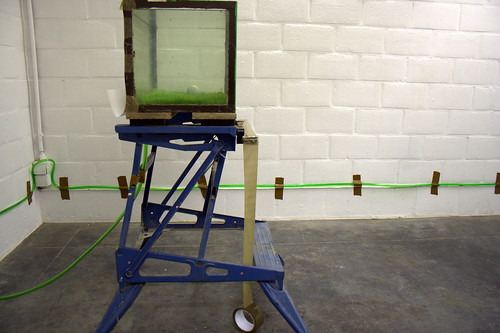
2006. crox 145, Basics 2 sequel.
2007. crox 203, Finding Nemo. Project in de kubusruimte.
Tweede periode Zennestraatproject (oktober 2009). Eén van de elementen in de presentatie van Nicolas Leus is een foto van Wim De Waegeneer. De foto werd genomen aan de Belgische kust op 11 september 2001.
Publicaties.
Stork Street University, folder. circa 2005
Ménagerie. Een al evenmin praktische gids voor de wildernis. Ed Stork Street University 2008. Eerste zin: 'Voorpoot rechts naar voor, in rust op de dode veren, dode veren met een hardleers oog vooraan op een rotsblok; hij komt van verder, alsmaar verder en trotseert edelgewei en een bergflank, eerst de schaduwstrepen van één der bosjes door, maar ook niet zonder hulp van een aureool van wattige wolken, precies daar, bovenop de horizon als een statistiek. Ze houden er niet van naar wortels en knollen te graven, dat lees je zo van hun gezichten af, van hun houding ook, want staan ze niet met hun achterste naar jou gekeerd, dan toch doemt hun gehouwen hoofd op uit de donkere zijde van het landschap. Steeds met die nare blik.'
98. TIPS. June 1999. Presentation in the basement of Aannemersstraat 54. Drawing, Photography & Indirect Mailart Correspondence. Simultaneous a presentation by Larry Krone (US/New York).
crox-card 20. 1999.
110. BASICS 1. Group show with drawings. November 2003.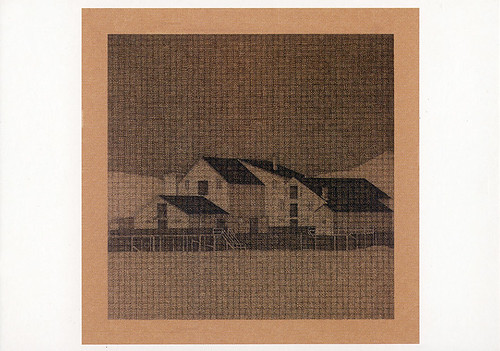 crox-card 20
145-1. BASICS 2. June 2005.
145-2. BASICS 2, sequel, Maagdedale Abbey, Oudenaarde. April 2006.
178. LA BELLE AU BOIS DORMANT. Solo presentation. May 2006.
PARTICLES. Crox-book 2, 2006. 80pp. 350x. Sold out.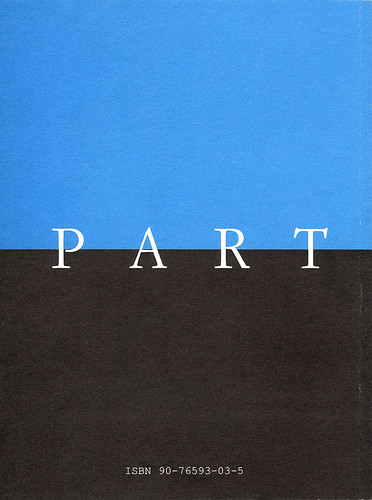

crox-card 29. Oslo (2005), photo 36 x 27. 2006. 29
29 30
30
crox-card 30. Until Death Do Us Part. 2006.
Member of the board from June 2006 to 2011. Joins the ALV. Editor.

 brainbox 1 unit 3
188. BRAINBOX 1. [3] With Peter Morrens and Ward Denys. October 2006.
VERZAMELWOEDE. Project at Maagdedale Abbey, Oudenaarde. 2007. TIPS.
299. ZENNESTRAAT 17a RUE SENNE. Coproduction with a.o. Secondroom, Fortlaan 17, Bains Connective. Alda Snopek, Christophe Lezaire, Johan De Wilde, Marc Coene, Steffie Van Cauter. April May 2009, Brussels.
crox-card 75. Memento vivere (2005). 2008.
477. VERF NA VAN EYCK [PAINT PAST VAN EYCK}. 2014.
crox-card 122. History 063. 2014.
485. LENS NA SPINOZA. [2] Triptych. Group show with Bram Van Stappen, Dirk Zoete and Patrick Everaert. 2015.
 580–584
549. Johan De Wilde & Christophe Lezaire. Location Zilverhof 34, October November 2017.
580. FOOD MATTERS. 43 artists 43 hosts 43 guests. Host: Pieter De Clercq. Guest: Bart Maris. 2018.
584. FOOD MATTERS the book. 2019.
from TOUGH GUY, SOFT SPOT - Review by Edith Doove about the projects by Larry Krone (crox 97) and Johan De Wilde (crox 98), De Standaard, 9 June 1999: --- After all this handywork the drawings of Johan De Wilde at first sight are reminiscent of cross-stitch patterns. In the basement of Croxhapox he shows part of a series of drawings he has been working on for some six years now.
The starting point is a square of 50x50cm. That is the foundation for an inventory of factual matters by means of landscapes, utensils, architecture and still-lives. All these images start from a painstakingly developed underlying pattern which De Wilde targets with time and memories. Each of these representations have a strong autobiographical background. The research for the place of self is also expressed in a mail art project where De Wilde sent letters to himself in all European countries. The bizarre hints De Wilde includes in his letters come back home empty-handed because obviously his Ghent address is unknown abroad.
PARTICLES crox-book NR 2 (May 2006) is the first book which is entirely in crox-format, apart from one small detail. 'In this book,' says the artist, 'are notes that originate in the periphery of my drawings’ - literally: short notes he scribbles during his hours of methodical and intensive drawing. Something about his modus operandi for example: the grid is blended in with the so-called representation. More or less as with the craquelures on a panel. The lines of the grid point at noise, disturbances. They influence memories, thoughts, the emergence of images. Tech savvy humanity removes grains and lines from the images. The real disturbance is in the forming of images as such. A clumsyness: the impossible as a sum of possibilities.' (op. cit. p.62)
La Belle au Bois Dormant, the second solo project of JDW (May 2006). Simultaneous with the project release of the second crox-book and two croxcards, 'Oslo' and 'Untill Death Do Us Part'. Apart from drawings and photos (the regular work) JDW presents also a series of approx 360 photos from > Oslo turned into a moviefilm. In two consecutive walks he travels the entire trajectory of the Akserselva, partly on the left bank, partly on the right, first from the city center in the direction of the source and then all the way back to the mouth. It probably wouldn't have been entirely similar if it were the Neckar in Trier: the river Akerselva, of very humble descent springs from a lake in the neighbourhood of Oslo and circles the proper city center southwards to discharge itself - after having flown beneath an industrial area for some time - in a southern fjord. Vincent D'Hondt composed a 40 minute emphasising the filmic essence of the slide projection.
At the first edition of BRAINBOX (Autumn 2006) it is the third unit - Ward Denys, JDW and Peter Morrens - which unleashes the actual essence of the brainbox process. It is the first unit proposing a collective work. (see > brainbox)
crox 126, installation window (Onderstraat 26) - November 2004.
crox 145, BASICS 2 - June 2005.
1990. crox 9. Schilderijen. Het tweede project nadat croxhapox een aanvraag deponeerde om als vzw erkend te worden. Kleine schilderijen met een horizontale en lineaire opdeling van twee vlakken, het ene vlak boven, het andere vlak onder. De tonen zijn overwegend groen.
1991. crox 17-1. Neemt deel aan de eerste editie van het fotocopy art project met een tot omtrek gereduceerd zelfportret. De voor de crox-multiple gemaakte variant is, met het werk van Olbrich, de interessantste bijdrage. Het ovaal van het zelfportret en het duplicum van de ruimte om het ovaal heen hebben dezelfde kleur.
2006/2007. Introduceert croxhapox in Oudenaarde. Twee projecten die onder het label Erfgoeddag vallen. Het eerste project is een sequel van crox 145, Basics2.
1997. Concert during opening night of crox 67 (Debra Pearlman). Dead Marcel is a group with Michaël Borremans (g), Nicolas Leus (saxofoon) and a drummer who guzzles Bourbon and persistently plays out of measure, not from any sort of feeling for multirhythmics, quite the other way round.
First solo project in Glamor is Undead, a fresh art space in Antwerp downtown, March 2006. First crox-project - Not Enough Middlefingers 2 - some months later, a solo project combined with projects by CarianaCarianne, Debra Tolchinsky, Dianna Frid and Sarah Westphal. Participates in the sequel of the BASICS 2 project. Performance & video, photographs and multi-layered gadgets. Later a performance during the 2006 edition of the local Culture Market. Joins >The Singing Painters during a short period. For more information on the first solo project, see >video.
[Dutch tanslation available, original in English]
La trajectoire du cyclope. 2015. Crox 505, kosmografia, een project van Edwin Carels. Perstekst (EC):
Een man begint te wandelen, om komaf te maken met de vervreemding, met
de mechanische monotonie van zijn handenarbeid en met de hele
maatschappij. Dit eenvoudige gebaar leidt gaandeweg tot een radicale
daad van existentiële herbronning. Een film zonder woorden, waarvoor het
sonore universum werd gecomponeerd door Sylvie Bouteiller. Voor de
installatieversie van de film wordt de proloog van de film afzonderlijk
op monitor vertoond.
https://vimeo.com/136560196
a. Corps de la terre. Een kever kruipt, scharrelt. Wordt getoond op een iPhone. Er is een direct verband met c.
b. Corps du Despote. Wordt op een monitor getoond. Een hebryde, anatomische studie van het lichaam van de despoot.
c. Corps du Capital. Het tekstfragment van (EC) verwijst naar dit deel van het triptiek. Een zwart-witfilm zonder generiek. Tijdsduur circa 50 minuten.
De eerste episode toont iemand, een man op een traktor, die een veld hooit. De camera zoomt in op de vele details van het mechanishe werk. De cadrage, de bewegingen en de montage zijn verbluffend. Iemand heeft het over Eisenstein. Vooral de montage is verbluffend: het ononderbroken spasme van beelden, van fragmenten van wat het oog gezien had kunnen hebben, wordt een maalstroom. De tweede episode begint abrupt, onaangekondigd: het wandelen begint.
Over de landschappen schreef Jennifer me dat het in de Franse Alpen, in Huesca en in Charleroi opgenomen werd. Over de main character dat hij geen acteur is, maar iemand die in de Alpen een kleine hoeve heeft, over het script dat ze eerst op zijn terrein filmden en dat hij ermee instemde om mee te gaan in het idee van de film.
Decaluwe, Bas
ARMEE LEGER, crox 163, January 2006.
Video projection. Two films: 'Paradis articifiel' and 'L'homme et son désir'.
The other artists in the Armee Leger project are Christophe Engels, Wouter Feyaerts, Thomas Campaert and Tim Van Ham.
Miet Warlop and Sophie Durnez join the group with a side project in the long corridor from the hall to crox3.
December 1990: Daniël Libens, Cahiers panoramiques (crox 11).
December 1991: Copy Art project 1. Antiracistische affiche (crox 19).
December 1992: Copy Art project 2.
December 1993: noppes.
December 1994: Dirk Peers (crox 23).
December 1995: Michaël Borremans (crox 33). Gery De Smet (instalraam, crox 34). December 1996: Sjoerd Paridaen (crox 55). Concert: Memaz. Ludo Engels (instalraam, crox 56). Maria Blondeel (21 december: interactieve audiovisuele installatie).
December 1997: Schilderkunst Hedendaags Belgisch.
December 1998: Thomas Huyghe (crox 86). Zjuul Devens (crox 87).
December 1999: Michiel Van Cauwelaert, From morning till dawn.
December 2000/2001/2002: niets.
December 2003: Basics 1.
December 2004: instalraam van Kurt Duyck. In de croxruimte projecten van Carole Vanderlinden en Pieter De Gand. ALV waarbij op uitnodiging van het bestuur een aantal nieuwe leden worden voorgedragen.
December 2005: instalraam van Samir Boudia. Projecten van Thé van Bergen, Jos Van Meerssche en Stef De Brabander. Aanslepende bestuurscrisis.
December 2006: Brainbox, unit 6 (Alda Snopek, Merlin Spie, Ludo Engels) en unit 7 (Anton Cotteleer, Stijn Van Dorpe, Nicolas Leus). In de andere ruimte het eerste project van het kunstenaarsduo WELD. In het instalraam is een project van VZW VroemVroem, in de kubusruimte VedeZe met een reeks fotomontages die eerder in 'Wat u moet weten over het Vlaams Belang' van politicoloog Marc Spruyt gepubliceerd werden.
December 2007: crox 238, een instalraam van Tamara Van San op de gebruikelijke locatie vlak tgeneover Pink Flamingo's. In de croxruimte de presentatie van WHAT ABOUT CROXHAPOX (crox 186), een door Frips en Marc Coene gecoördineerd mailart project waaraan 200 kunstenaars deelnemen. Schilderproject 1 (crox 239) combineert werk van 6 kunstenaars: Carole Vanderlinden, Gerd Ververs, Florin Buta (RO), Kurt Duyck, Stef De Brabander en Ian Kesteleyn. Een project met een chaotische historiek wat ook wel uit de presentatie blijkt. Op de werkvloer is het FF die de skepter zwaait. Er zijn 2-wekelijkse werkvergaderingen en Luc Pieters schetst de krijtlijnen van wat de nieuwe website worden moet. Midden december stapt FF op als Algemeen Directeur en bestuurslid en meteen ook als lid van de vereniging. Op redactioneel niveau hebben we twee publicaties in aanbouw, crox-boek nr 8 van Philippe Vandenberg en The Gentlemen's Gentlemen van Brian Getnick en Noe Kidder, crox-boek nr 9.
December 2008: crox 282, Buried Alive, een video-installatie van Adam Geczy (AU). Solo projecten van Sander Buyck en Lien Nollet. In de kubusruimte het eerste deel van een triptiek van Nel Aerts. De tweede editie van Brainbox zit in de vierde fase, een ingreep van Peter Morrens, Griet Dobbels en Deborah Delva. In de zaal achterin is het Siberisch koud. De presentatie van unit 3 wordt versnipperd, de corridor afgesloten met iets wat op een werkhok lijkt, en in de zaal zelf zorgen grote, industriële ventilatoren voor een constante luchtverplaatsing. van heeft een nieuwe auto gekocht en maakt een testritje naar het zuiden van Spanje. Het gaat over Barcelona (waar hij z'n laptop en pasgekochte Canon kwijtraakt), Tarragona, Murcia, Almeria en Màlaga naar Jerez de la Frontera en via de Algarve weer noordwaarts naar Lissabon en Madrid waar hij Marta Vera opzoekt.
December 2009: De vijfde presentatie van Svend Thomsen's TVF art archive focust op theater: crox 289-5 TVF art archive presents the theatre n°1 compilation. rafaello sanzio: amletto 1995 - giulio cesare 1999, patrice chereau : dans la solitude des camps cotton 1995, howard baker: hated nightfall 1995 - ursula 1998, eugenio barba: ego faust 2000, peter brooks: oh les beaux jours 1997, simon mcburney: FOE 1996, silviu purcarete: faedra 1995, marianne weems: jet lag 1999, gerald thomas: flash and crash days 1994, jacob schocking: manifest 2000, gilla cremer: die kommandeuse 1996, heiner goebels: max black 2001, ju xi & jian che: the hospital 1996, joan grau roca: hibrid 1995, SOFA trio: titanic and me 1994.
Projecten van Yoshimasa Matsumoto, INVOLVED (crox 321), en Karin Borghouts, VIEW IN A JAPANESE GARDEN crox 322). In de kubusruimte een presentatie van Jerry Galle, DOUBLE YES (crox 323). Rob is het voorbereidende werk aan het boekproject van Julian Moran kwijtgeraakt. Computer gecrasht. Luc Pieters laat weten dat het werk aan de nieuwe crox-site bijna voltooid is. Enkele weken later, begin januari 2010, gaat de nieuwe site online. Tijdens de finissage op 20 december een klankinstallatie van Dirk Veulemans, KIKKERS IN EEN RIJSTVELD, een titel die hij een opmerking van Yoshimasa te danken heeft.
December 2010: Instalraam Ada Van Hoorebeke. Projecten van Kris Van Dessel, Robin Vanbesien en Martin Sommer (DE). In de kubusruimte is een project van Reinhard Doubrawa (DE), het is er sinds oktober 2010 en wordt verlengd tot eind februari 2011. Net voor de winterstop is er het TANTAMOUNT event, een project van Timelab gecoördineerd door Annelien Vermeir, Dries Douibi en Masahiro Saito (JP). In croxhapox is de livestream te volgen.
1996. crox 51, Open Deuren. 3 drawings about Maya. DD is hosted by Patrick, Philomena and Mascadora Verlaak. In the houses next door Dirk Braeckman and Peter Simoen present their work.
fragments of a correspondence by Gmail:
Gregory to van - 09/05/07
Je vais lui écrire très prochainement.
C'est OK pour un grand projet pour l'Automne 2008! Extra!
Viva Croxhapox! Viva GM!
Courage pour l'encyclopédie;-)
Le 14 mai, n'hésite pas à m'appeler sur mon GSM quand tu sera sur
Bruxelles et disponible.
Bien à toi.
Merci encore.
Grégory
Gregory to van - 10/05/07:
Pendant un certain temps, j'ai signé dans la rue Diog la contraction
de Diogène, c'était une manière pour moi de faire du diogging ;-)
Aussi, j'ai collé des autocollants arbre GM, sur tous les poteaux de
la grille qui entoure le parc royal de Bruxelles. En quelque sorte,
par ce biais, je me suis approprié ce parc, qui est tout près de chez
moi. Depuis, quand des autocollants sont arrachés, ou enlevés
délicatement, je m'occupe de l'entretien, je colle à nouveau un arbre
GM sur les poteaux dénudés.
Lorsque j'étais entrain de coller le demi cercle sur le panneau
routier signalant un ralentisseur, près de Porte de Namur, à
Bruxelles, un passant s'est exclamé: Ceci n'est pas un panneau. Je
ne pouvais rêver mieux!
Coller des autocollants dans la rue m'a permis de faire des rencontres
extraordinaires.
Pas plus tard que cet après-midi, sur un trottoir menant au
rond-point Montgomery, une voix vindicative m'interpelle sèchement
pour me demander ce que cela signifie ce dont je suis entrain de
faire.
Ce ton me fait sursauter. J'étais alors tranquillement entrain
d'apposer un minimaliste masque blanc, sur un panneau flèche
prioritaire se tenant sur le même trottoir que la pharmacie d'un
petit monsieur sans âge. Où le bonhomme s'apprêtait à rentrer en bon
client fidèle m'a-til semblé.
Je lui ai balbutié un semblant d'explication, lui expliquant bonant
malant que j'étais artiste et que j'intervenais sur les panneaux
routiers.
Il me coupe alors la parole, en me parlant d'un obscur homme politique
belge qui ne serait qu'un menteur, puis l'instant d'après, il m'affire
que Ségolène Royal elle aussi, ést une menteuse, qui ment mal en plus.
Qu'elle s'est ridiculisée lors du débat face à Sarkozy, en voulant
piéger son adversaire en lui posant une question dont elle-même ignore
la réponse.
Je lui explique dès lors, en lui décorticant le panneau, que
l'autocollant est sensé faire apparaître, de manière extrêmement
schématique, un visage au milieu de ce panneau, tellment familier,
tellement rongé par le quotidien qu'on finit par ne plus le regarder
du tout.
Ses yeux s'illuminent, il le voit désormais ce personnage moustachu,
mais pas encore la casquette vissée sur la côté, il me dit même qu'il
l'aurait collé plus haut sur la forme noire.
J'insiste, qu'il n'y a que c'est endroit pour que l'illusion de la coiffe soit.
Il comprend, voit entièrement, me remercie, me dit qu'il reconnaît les
gens qui mentent, parce qu'il ne savent pas ce qu'ils disent.
Sa pharmacienne le rappelle à l'ordre, on l'attend, sa compagne
peut-être, on se salue très sincèrement, le cours de nos journées
respectives reprend son cours.
van to Gregory - 14/05/07
pas. J'ai déja téléphone à Aeroplastics pour lui dire que lundi est
vraiment impossible. Alors je ne serais pas a Tropismes ça va de soit.
Gregory to van - 14/05/07
Je suis ravi que les visiteurs de Crox apprécient mon truc comme tu
le dis si bien!
Je serais tout à fait enchanté de rencontrer le trio liègeois, c'est
vrai que tu m'avais déjà parlé d'eux, je me souviens que tu m'avais
raconté que l'un dentre eux avait dessiné, lors d'un séjour en
Turquie, les trajectoires de fourmis qui passaient sur sa feuille.
J'aime, comme toi, ce genre de démarche.
Voici le site d'un des GM, qui travaille la lumière plus
particulièrement, pour le grand projet GM, je pense que le cube lui
conviendrait parfaitement pour y intervenir.
Je viendrais avec lui te voir à Croxhapox, selon tes disponibiltés.
van to Gregory - 14/05/07:
Eh bien, of course, les courses. Le type se présente comme un type
assez sérieux. Je veux dire il ya du sérieux et le sérieux et le
curieux et du curieux. Curieux, moi.
Il faut l'introduire. C'est, comme tu le dis si --- (ça existe ce mot?
mais si ça n'existe pas, ça faut un peu d'existence) --- Le
déracinement. Avec un ou avec deux n's. Se déraciner. Peindre les
noirs blanc et les blancs noire. Enlever les morts de ses trous cocus
et admirables et les tuer. Il faut tuer les morts. Ils n'ont rien
d'admirable et ils s'en fouent. Ce que je n'aime pas. Je n'aime pas
qu'ils s'en fouent.
The first project Wouter participates in is BASICS 1 (crox 110), at the end of 2003, with a series of technical drawings on drawing paper.
In 2005 follows an installation window in Onderstraat and participates in both editions of BASICS 2 (crox 145), like BASICS 1 focused on processes of thought and work. In this case starting with the idea of 3D.
In 2007 he presents 'Pliable Landscape' [Plooibaar Landschap] (crox 200) a modular sulpture made espacially for the space of crox3.
Publication of "Uchronie" - originally planned for the end of February 2007 - under preparation.
Plooibaar Landschap > croxcard 54.
518. ELF NA TWAALF. Projectcluster met presentaties van Allora & Calzadilla, Benjamin Verdonck, Els Dietvorst, Hana Miletic, Karl Philips, Elly Van Eeghem/Ruben D'Hont (i.s.m. inwoners en schoolkinderen van het eiland Malem], Debby Huysmans en Babs Decruyenaere. Maart april 2016.

Crox-card 137. z.t. 2014 gelatin silver print. 2016.

xxx
Solo presentatie in de corridor, november-december 2011. De menselijke atlas van Gent, een fotografische visie op de nieuwe stedelijkheid. 'Territorium, taal en identiteiten vallen niet meer samen, zoals in de moderne 19de eeuw en 20ste eeuwse staten en steden gebruikelijk was, en de wijken worden veelgelaagd. In om het even welke Gentse wijk, wordt tegelijkertijd een Afrikaans feest gevierd, een Mongools huwelijk gesloten, Marokkaanse hapjes gemaakt door moeders tijdens een schoolfeest op een stedelijke school, gemusiceerd tussen Armeense, Hongaarse en Vlaamse muzikanten, terwijl een buur een liefdessoap volgt op de Turkse televisie. Ondertussen spelen hun kinderen samen voetbal in een of ander jeugdhuis en winkelen de vrouwen in de supermarkt en staan ze aan een loket van een of andere publieke stadsdienst, in een situatie van "superdiversiteit", d.w.z. binnen een straal waar je de wereld bijeen ziet.' (uit de zaaltekst)
Het project valt samen met presentaties van Freya Maes, Giannina Urmeneta Ottiker, Nele Van Canneyt en Yuji Harald Matsumoto.
>Couckhuyt, Guy. Connoisseur and collector of free jazz and experimental music. Sublime collection of vinyl. At the end of 2005 one of the earliest extra-projects in the media space:a collection of sleeves of experimental music from the seventies till today. en Performance at opening night of Basics 2 (2005) and sequel Basics 2 (2006).
>Deaf Nose.
>Dean, Jamez Dabramski wholsales in alter ego's: Code Gema; Midgets on Porn; Mister & Misses Dean; Nina Demanis; Squirrel Liberation Front; Kamikaze Toy Boyz; Jamez Dean & The Dollars.
>Thomas Huyghe. Deejay set on Saturday 9 December 2006, opening night of brainbox unit 7.
crox 110, BASICS 1, November-December 2003. Plus minus 200 drawings of all in all 25 artists. Evert has a series of 70 digitalprints, thee embyronic phase of the solo project he shows at the end of 2005. In January 2004 crox 112, Window One, an installation at the usual location, Onderstraat 26.
Participates in the first edition of BASICS 2 (crox 145). SPACE! follows in the same year, a solo presentation in the front in the largest space. He is present again in 2006, first in the sequel to BASICS 2 in Abbey Maagdedale, later in the Brainbox project, second stage, in collaboration with Carlo Mistiaen and Thomas Bogaert.
Evert manipulates the clay cube Anton Cotteleer had put on the small bLAck table on top of the ytong sculpture and truns it into a cloudlike mass. the end product of his intervention is a short b/w film showing the process of mutation and projected at a side of the ytong sculpture.
Participates in the second edition of Brainbox (2008-2009), eleventh and last unit, in collabroation with Adriaan Verwée and Dirk Zoete.
BRAINBOX 1 - unit 2 /fragment of a text/
Saturday 7 October 2006, 15:25 > 15:30 /day 37/
evert
Evert sprays the clay. Evert sprinkles the top of, the side, the inside of, the outside.
The ... (noun) is a ... (adjective) and good animal.
The mass of clay behaves as. (replace by: acts as if)
Say ‘hello Evert’.
(murmuring voice) ‘Hello Evert.’
The sound installation ...(verb) deafeningly loud. Chokes the small talk of a ... (number of visitors). She speaks French:
‘Elle a un chocolat.’ He speaks English:
‘She has a chocolat.’
Evert shakes the ... (object) over the clay sculpture. All of it, to the last drop.
Having finished this he leaves the main room.
In the corridor, the text ‘elle a un chocolat’ lights up.
Evert doesn't return.
Mass of clay. Lumbering. Sits. Married couple. Sprinkler.
crox 110, BASICS 1 (2003). Drawings.
crox 128, solo project (November 2004). Drawings and paintings.
Publication of croxcards 23 & 24 (2004).
Logistic support for the preparation of BASICS (2005).
crox 145-II, sequel BASICS 2 (Abbey Maagdendale, 2006). Presents an object.
Logistic support for the renovation of the cafeteria and the sanitary installations.
Radio For The Village uit 1988. 5,26" durend video-document uit het TVF art doc archive, gepresenteerd in de reeks Performance Theatre N°1: Site-Specific.
> circumstances
8 mei – 5 juni 2016. Groepspresentatie.
Protagonisten: 521. Fabrice Pichat (FR). 522. Gill Van Eeckhout, Laura Van Severen, Henk Delabie, Robin Vermeersch, Peter Lagast. 523. Bruno Vandenberghe. 524. Yannick Franck, performance. Elisabeth Van Dam, performance.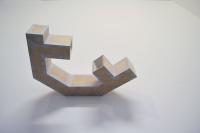
Herzamelen, 29 april - 1 mei 2016. >Vanhille, Emma
a/ herzameling 1 : K S
b/ herzameling 2 : twee octaven
zaal voorin
> Und
LD maakt deel uit van de definitieve selectie van Signos de Admiracion (1990/92). Het zou een containersculptuur worden. Eind 1991 zat het project ook al zo ver dat elke creatie een definitieve plek in de Gentse binnenstad toegewezen kreeg. In de documenten die FF bijhield, is niet meteen terug te vinden waar de triomfboog van Deleu gepland was.
-->Signos
Een van de groepsleden van KAMP, een kunstenaarscollectief dat aanvankelijk - net als HAP enkele jaren eerder - 3D als uitvalsbasis heeft (intussen Multimediale Vormgeving, KASK).
TD maakt deel uit van de werkgroep die zich in 2004 en 2005 over het project van Tazro Niscino buigt, een project dat uiteindelijk door het SMAK uitgevoerd wordt. In 2005 volgt Tankgarage, een werk in situ in Zelzate met docu-display in croxhapox.
Ontroerend moment tijdens een tussentijdse jury aan het KASK: Tuur motiveert het feit dat hij er niet in slaagde om in zijn werk een doorbraak te realiseren. In dezelfde periode neemt hij met KAMP deel aan beide edities van Basics 2. KAMP neemt ook deel aan Verzamelwoede, na de sequel van Basics 2 opnieuw in Abdij Maagdedale, waar ze een bijzonder ingenieuze ingreep realiseren, een stapelkast die als een van de vele honderden objecten op de 50 meter lange tafel staat. Een detail: de schuifladen van de stapelkast steken dwars door de muur van de bovenzaal.
TD is een van de stichtende leden van IPS, een tentoonstellingsplek op de bovenverdieping van het International Press Centrum aan de Rooigemlaan.
crox 196, January 2007. Installation window, location: Onderstraat 26. Covers the window panes with buttermilk. Every small vertical strip is clear glass. At the top and at the bottom there are hardly noticeable sideways shifts resulting, for the careful viewer, in an impression of open windows.
crox 300, April-May 2009. A group project, coordinated by Stefaan Dheedene, with works from Niklaus Ruëgg (CH), Frederik Van Simaey, Dries Verstraete, Stefaan Dheedene and Deborah Delva.
Two brilliant objects by Deborah Delva. Is less more? Simple interventions. On one of the walls she projects a slide of which only a tiny fragment remains visible. Right across, there is a video projection: a ball bouncing time and again against a wall. Only one fragment of the course and the traject of the bouncing is shown.
1996. crox 51, Open Deuren.
2009. crox 277, Brainbox 2, 8ste unit. Is samen met Thomas Böing (DE) en WELD.
512. ATLANTIS NA PLATO. 17 januari - 14 februari 2016.
Presentaties van Alejandra Hernandez (CO), Bram Demunter, Clara Spilliaert, Femmy Otten (NL); Johanna Kristbjörg Sigurdardottir (IS), Klaas Rommelaere, Nina Yuen (US), Olga Fedorova (RU) en Renée Spronken (NL).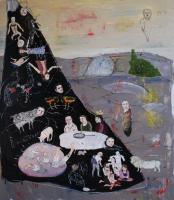
crox-card 134. Wellustigen (2015). Olie op doek, 50 x 40. 2016.
 crox-card 134
1995. crox 32. NATION NOTION NOTATION NUTRITION. Installation window at Onderstraat 51 and Onderstraat 26.
Krysztof Denek (CZ, 1961, Brno). Dies in 1998 in Nicaragua.
Although no reviews have been written on the november 1995 window project by Krysztof Denek (Luk Lambrecht, then writing for De Morgen, wrote something on the window presentations of Phill Niblock and Jens Brand, two months later, early 1996) the in situ work that Denek created on both Onderstraat 26 and Onderstraat 51, two windows on number 26, two on number 51, opposite of each other, made a strong impression on those who saw it. Each window had a huge pile of newspapers, so high that it made the impression of a twin tower double. Likewise the space behind each window had red curtains, looking as stage curtains, and a violent red was spread over the inside of each window. A saw stuck halfway each newspaperpile. The piles had editions, I remember, of American, German, English and Chinese newspapers. Denek may have made photographs of the work. In the crox-archive no relicts remain. I recall that he had travelled in China, Indochina and South America. Born in Brno he had a fluent English pen. I can't remember if his mother was an American or not. All of his notes were in English. In 1996 we met in Tate, where he stood in front of Douglas Gordon's vampire. He told me that he had moved to Bratislava, on the Danube, and introduced Bruce Chatwin.
BRAINBOX - unit 3 /fragment of text/
15:00 /day 40/
johan de wilde, peter morrens, ward denys (unit 3)
Johan and Ward are in the main space. They are waiting for Peter.
The from dark atmospheres plucked bald skeleton of brainbox unit 2 remains in the room. It takes the appearance of a wharf where nothing has happened for a long time. The Bauer film apparatus has been removed.
‘If only that part would get painted today...’ Johan volunteers .
Basically it's a trifle: tomorrow they will have all kinds of tools available and then they can have a go at it.
Somebody connected a fan to the circuit of the sound installation.
‘Does Peter put that fan...?’ is what this author wants to know.
‘No,’ says Johan, ‘that’s mine. But I'll take it away in a minute.’
Ward and Johan move to the storage space in the back of the white room and check the available timber.
The passage is cleared. What could they do with the timber? Is there enough? Is it ok?
The warden[1] has an anouncement to make. Actual acknowledgment concerns the fact that a part of the supply of timber, specified herewith, cannot by any means or for any reasons or goals however honourable be employed in the envisaged constructing activities: this is Sjoerd's axiom. ‘I didn't know Sjoerd had an axiom,’ Johan remarks dryly.
‘Oh yes, the Sjoerd Axiom...’ The warden grins sheepishly.
Meanwhile Peter phoned in to say he was on his way. Maybe ten minutes, is what Johan surmises.
Johan and Ward cross the room and climb the steps to the roof.
‘Well, yes...,’ says Ward, after they have been deliberating one and the other. He descends the stairs and journeys to the entrance. Reappears in a whisker. A tape measure, is what they need.
After some time, footsteps resound and enter: Peter.
,Hey, hi.’
This author digresses on a lapsus tipa [typo] in one of the previous fragments: "ferntable" instead of "turntable". ‘I honestly turned it into a ferntable, can you imagine,' he says. [original Dutch: plantendraaier iso platendraaier]
‘Ferntable is a lovely word,’ opiniates Peter. He ascends the stairs to the solarium.
Johan hurries down the stairs, cuts swiftly through the room towards the storage and takes off his raincoat. There is some noise in the storage room. When he reappears he holds two tile laths.
‘Lend a hand?’
He nods no. ‘We gonna check...,’ he expletes.
What are they up to? There are voices, thumping, than silence, and the smart sound of the tape measure and an mumbling voice. ‘OK,’ says someone. Than a crescendo and again, for a few moments, silence.
This author takes a look at the roof. The laths cross the oblong pit. Peter, Johan and Ward discuss how they could take the mdf – 20mm mdf plates – upstairs.
Halved, proposes Ward.
[1] Here un unintentional but nice play on words between Ward and warden occurs. Warning that the Warden is not Ward neither is Ward to be warded - hehe.
2007. crox 237, animated movie. Presentation in the hallway at the wheeled table-object made by Stijn Van Dorpe.
2009. crox 287. Duo project: Maud Vande Veire & Emmanuel Depoorter. Installation, objects, video, performance and photography. In the front of the large room.
Een selectie uit de reeks crox-cards is te vinden in Boekhandel Limerick (Gent), Het Poëziecentrum (Gent) en Museum Dhont-Dhaenens (Deurle). Circa 2010/11 was er ook een beperkte selectie in voorraad in Librairie Saint-Hubert (Brussel) en in het Gentse Popville.
In de crox-ruimte, Lucas Munichstraat 76/82, zijn los van de eigen publicaties ook nog volgende edities te vinden:
Anoniem eerste helft 21ste eeuw, het balanseer/croxhapox (2013) crox-boek nr 17
Chipka, Netwerk (2010)
Cum, An Orderly Fashion, Cum/MER (2009)
De Witte Raaf (gratis)
Dirk Slootmaekers, Things made visible, Huis Hut (2013)
Een foto zegt meer dan 1000 woorden, Tornado Publ. (2008)
Freya Maes, Het rijk der vrouw (2004)
Giannina Urmeneta Ottiker, Un-There (2010)
Hans Theys, Focus, Snoeck (2012)
H-art
Imprimitiv, een initiatief van Sébastien Conard: Grid + Lamer, Dirk gaat op vakantie, Guy Goggle takes a break, Guy part en vacances, Aambacht 1 (met losse bijdrage 'Ecrire comme à Lisbonne) en Aambacht 2
Johan De Wilde, Akerselva-Oslo (het balanseer) (2012)
Johan De Wilde, Ik wordt (Voorkamer) (2013)
Johan De Wilde, Akerselva, SMAK/het balanseer (2014) vinyl
Joris De Rycke, Plorp (2012)
Kantelingen (2012)
Kunstkrematorium, Galerie Julie August (2010)
Marie Zolamian, Un lieu d'élection (2011)
Markus Willeke, During The Crisis, GWK (2005)
Markus Willeke, One More Thing Before I Go, Kettler Kunst
Mehdi-Georges Lahlou, Edition postale (2010)
Mehdi-Georges Lahlou, Les talons d'Allah (2011)
Michiel Ceulers, Viele farbige Dinge nebeneinander angeordnet (2009)
Michel Couturier, Zones de chalandise, Yellow Now (2009)
Nate Wooley>Thrown Down your Hammer and Sing (Wooley, Lonberg-Holm, Roebke) & Sheldon Siegel live at Les Atelier Claus, Smeraldina-Rima/croxhapox (2013) vinyl
POSTURE editions: Adriaan Verwée, Hannelore Van Dijck, Dirk Zoete, Carole Vanderlinden...
RE: A Group Show (2012)
Reinhard Doubrawa, Alles / beispiele und details, Salon Verlag (2011)
Reinhard Doubrawa, News, Salon Verlag (2004)
Reinhard Doubrawa, Special Values, Salon Verlag (2009)
Sachiko, Golden Hypnos, artwork Johan De Wilde, audioMER/croxhapox (2009) vinyl
Steven Tevels, Work in progress (2012)
Temporary City Berlin (2009)
Wim De Waegeneer, Ménagerie (2008)
Wouter Feyaerts, Plakkaten (2011)
Cineast, stuwende kracht van het Gentse OFFoff en als docent Luca betrokken bij alle residenties van Meesterklas Luca in croxhapox.
crox 417 KANTELINGEN. [Topplings] Group project, September 2012. Wall painting.
The Eclipse, a documentary. POV, Realities Revisited Part Three, juli 2013. Curator Nima Bahrehmand (Iran). Project with videos and films from Iran.
Nothing much is to be found about the life and the works of Kiumars Derambakhsh, pointed out by Nima as one of the most interesting Iranian filmmakers. In Companion Encyclopedia of Middle Eastern and North African Film: 'Formal experiments of an impressionist nature were also tried, such as in Kiumars Derambakhsh's Sarebanan/Desert Caravans (1974) and in Bazar Migeryad/The Bazaar Weeps (1976) made by two students'. IMDb on the other hand offers only this remark: 'It looks like we don't have have any External Sites for Kiumars Derambakhsh yet.' Onlinefilmhome.dk knows more. Born in 1945 (Iran), studied film at the Sorbonne, member of Greenpeace Society London.
2010. CHARACTERS MAKE STORIES, a project by guest curator Stijn Van Dorpe with works by Assaf Gruber, Fiona Mackay (GB), Robbrecht Desmet, Wobbe Micha and Stijn Van Dorpe.
A 8mm film by Robbrecht Desmet. The film was recorded in the Boekentoren, at the topmost floor, if I'm not mistaken the twentieth floor, the very same floor where Jan De Cock had projects twice.
I.P.P., Meesterklas Luca, improvisatieproject, 30 maart - 12 april 2015
crox 37, instalraam (Onderstraat 26) - januari 1996: De dans van de kleine mummie.
crox 51, Open Deuren - herfst 1996.
crox 87, solo project - december 1998.
crox 37 - Luk Lambrecht (De Morgen, Dag en Nacht, januari 1996 Niblock Brand): Aan de overzijde van de straat is Zjuul Devens gastheer met een tweedelige bijdrage. Aan de ene kant is een soort kijkdoos geïnstalleerd met een petieterige graftombe van een kikker en daarnaast vindt een monumentale diaprojektie plaats, die bij zonsondergang een verbluffend beeld brengt dat naar de tombe verwijst.
Het project van ZD loopt simultaan met een duo-project van Phill Niblock en Jens Brand op locatie Onderstraat 51 - het huidige Pink Flamingo's - vlak tegenover Onderstraat 26.
crox 51 - locatie 22: Bouwmeesterstraat 1. Zjuul Devens levert een handleiding bij zijn project, tekst die in de brochure opgenomen werd: Ik sta voor een deur, ik bel aan. Achter die deur is een intieme wereld die voor mij (nog) verborgen is. De deur gaat open en ik zie een hall, een gang. Een glimp van de identiteit van de bewoners. Ik ben een voyeur en probeer meer te zien, meer te ervaren van de leefwereld van de mensen die hier wonen. Ik activeer mijn zintuigen, ik ruik soep, hoor een radioprogramma, ik zie een gang, ik word nieuwsgierig: wie zijn zij, hoe leven zij? Tot waar laten ze een vreemde toe in hun afgesloten wereld?
De gang is een sluis, een buffer tussen de buitenwereld en hun cocon. De gang versluiert hun wereld voor anderen. Ik zie enkel een projectie van die wereld en die projectie wordt duidelijker naarmate de gang zijn sluiers laat passeren: de laatste sluier is een projectiescherm en toont beelden van een intimiteit waar ik niet bijhoor. Ik weiger dan ook dat de bezoeker dit laatste scherm passeert. Hij zou trouwens verblind worden door de projector en weten dat hij een buitenstaander is én blijft. De bewoners beslissen wie toegelaten wordt tot voorbij hun gang. Ik heb toestemming gekregen om een stukje van hun intimiteit te herleiden tot een projectie, letterlijk dus!
crox 87 - Edith Doove (De Standaard, 9 december 1998): De techniek van de montage die Huyghe op zo'n boeiende manier in zijn werk incorporeert, wordt op een heel andere manier ook gebruikt door Zjuul Devens die eveneens in Croxhapox exposeert. Devens werkt met video, maar blijft -en dat is een manco van veel videokunst- te veel in het technische kunstje hangen. Tegelijk hanteert hij zijn techniek net iets te slordig.
Een citaat uit Mulisch'roman De aanslag aan de muur geeft aan dat een besef van het verleden moet samengaan met een besef van toekomst. Devens beeldt dta uit door met een kano de Zuid-Willemsvaart en de Maas te bevaren. Op de voor- en achtersteven plaatste hij een camera. De beelden daarvan monteert hij in één beeld, zodat je op de ene helft met de kunstenaar meevaart en op de andere kunt zien wat hij achter zich laat. Maar juist op de al te strakke scheidslijn tussen beide beelden loopt het jammerlijk mis.
303. Instalraam [window project. Onderstraat 26. Juni augustus 2009. Alle bevolkingsgroepen in het Gentse. Ook de aantallen.
370. OVER CROXHAPOX. Mei 2011. Een tekst over croxhapox uit het Kunstenpuntreservoir. De tekst komt in tien versies aan de muur van een van de zalen voorin. Met de vertalingen worden de belangrijkste allochtone bevolkingsgroepen in het Gentse gegroepeerd: Albanees, Arabisch, Bulgaars, Chinees, Engels, Hebreeuws, Pools, Russisch, Spaans, Turks. Stefaan Van Ryssen coördineert de vertaalopdracht.
(1) De Hebreeuwse vertaling is van een Joodse dame uit Nederland. Ze doet vaker vertaalwerk voor Daniël Dewaele.
(2) De Spaanse vertaling is de enige die door een vertaalbureau uitgevoerd wordt. Ze is foutloos.
(3) In de Hebreeuwse vertaling ontbreekt het woord croxhapox.
(4) Een bezoeker beweert dat de Bulgaarse vertaling, in cyrillisch schrift, veel fouten bevat.
(5) Urdu en Parsi ontbreken. Beide talen zijn in Gent sterk vertegenwoordigd. Urdu maakt gebruik van de Arabische lettertekens.
Inge Braeckman (H-art 82, blz. 16): CONCEPTUELE UITVOERINGEN IN CROXHAPOX. 'Op de gewitte muren van Croxhapox in Gent heeft de Belgische kunstenaar Daniël Dewaele een tekstwerk gemaakt en aangebracht, die letterlijk lijkt te refereren aan het credo waarvoor dit centrum voor experimentele kunst staat. Zo lezen we onder andere zeer sec: 'Croxhapox is a centre for experimental art promoting the wide diversity of contemporary visual arts. (...) At the centre of its programme is the autonomy os the artistic discourse.'
'Het doet onmiddellijk aan het Manifest van 'TRACK' denken. In de tien talen die in Gent het meest worden gebruikt en gesproken - onder andere ook het Hebreeuws en het Spaans - heeft Dewaele zijn tekstwerk als één band op de muren gezet. Hoewel in zichzelf besloten, tonen en zeggen deze letters, deze zinnen op de muur wat ze zijn. Zeer puur, zonder er iets aan toe te voegen. Deze 'conceptuele' kunstenaar, die bijvoorbeeld bekend is van zijn 18 brieven, ingelijst in plexi, die behoren tot de collectie van MuHKA, werkt wel vaker met woorden. Hoewel hij doorheen de jaren een oeuvre heeft opgebouwd dat bestaat uit installaties, performances, video- en fotowerken, geeft zijn werk steeds op een homogene manier het wezenlijke van de kunst en haar maatschappelijke relevantie weer.'
vraag antwoord /gesprek dd 04-07-11/
V. Of het crox-project nu eigenlijk een titel had.
A. Over Croxhapox. Dat is de titel. Zoals dat project over het ICC dat Over het ICC als titel had.
V. Of er eerder al vergelijkbare projecten waren.
A. De krantprojecten. (somt op) 5 keer Brugs Handelsblad, 50 keer Belang van Limburg, 4 keer De Witte Raaf, 2 keer Metro. 1 keer in de Vlaamse, 1 keer in de Franse versie. Met het Belang van Limburg het voordeel dat Grauwels daar werkte, die de sociale context van het project interessant vond (Nice To Be Also Represented, 2002, nvdr). Met Over Croxhapox wel de eerste keer op die manier met tekst.
'M'n werk maakt een aantal bewegingen... en dit keer was het zeer conceptueel.'
V. Het eerste project, wat voor project dat was.
A. In Knokke, in een kelder, een plek die Contemporary Art Gallery heette. Kleine plek, paar vierkante meter, meer niet. De meeste van die plekken toen waren marginaal. In 1977 was het. Vloer zwart geschilderd en daar het aantal vierkante centimeter op aangebracht. Een immaterieel project.
crox-card 96. Over croxhapox (2011). (deel van) installatie: kleefletters, variabele afmetingen. [2011]
607. Kunst & Zwalm (2021). BETWEEN MANY OTHERS. txt brochure Daniël Dewaele is autodidact. De relatie tussen kunst en maatschappij en de betekenis die kunst kan hebben voor de maatschappij is sinds ca. 1975 het actieterrein van de kunstenaar. Deze ontstond uit de reflectie over kunst en de relatie of interdependentie tussen kunst en economie, samenleving, ideologie. Dewaele beperkt zich niet tot het in vraag stellen van kunst. Ook het functioneren van kunstinstellingen, kunst als fetisj, kunst als handelswaar en maatschappelijke thema's als werkloosheid en racisme worden kritisch onder de loep genomen. Door bepaalde methodes te kiezen (enquête, interview, inventariseren ... )kan Dewaele net zo goed een sociologisch kunstenaar genoemd worden. De kunstenaar gaat in tegen het traditionele een richtingsverkeer tussen kunstenaar en publiek en hanteert niet de taal van de kunst, maar de taal van de maatschappij, door onder meer hedendaagse communicatiemiddelen te hanteren. A
Between many others ie een vertaalproject. De teksten op de affiche van de tentoonstelling KUNST & ZWALM werden vertaald in 7 talen: Pools, Roemeens, Tsjechisch, Arabisch, Russisch, Portugees en Hongaars. De keuze werd gemaakt op basis van de meest gesproken talen door mensen met een n iet-Belgische herkomst. De lijst werd gemaakt aan de hand van een bevolkingsoverzicht, opgevraagd bij het gemeentebestuur. Dit project werd bedacht om tegemoet te komen aan inwoiners van Zwalm met een migratieachtergrond. Door de onleesbaarheid van de aangewende talen zal er, voor hen die de aangeboden talen niet machtig zijn, een vreemdsoortige elegante communicatieve blokkade ontstaan: een vervreemdend effect tussen het Nederlands en de vertaalde gedeelten in een andere taal. Bij een affiche waarbij de teksten volledig zijn vertaald, zal die affiche bijna als een (taal)beeld functioneren. De vertaalde affiches en het verhaal rond dit project worden in de Sint-Dionysiuskerk tentoongesteld.
vraag antwoord [on conversations] from the kunst & zwalm catalogue
Who or what connects in your work?
Society.
What would you you like to do more often?
Being more tolerant.
What does collaboration mean for your work?
Sometimes it is real without limits, sometimes it is more on a conceptual level.
What touches / touched you in Zwalm?
Being in the shadow.
What is specific or local?
Hidden nationalities.
What do you value most in your friends?
That they do not talk about art. Art has too many definitions.
What can a community and outsiders offer each other?
A lot of things. I work with them, on a real or conceptual level.
How can a community provide refuge?
By not talking too much.
What is your favourite tea?
I prefer coffee.
What is participation for you?
Sometimes fun, sometimes a lot of trouble.
What do you need?
Nothing for the moment.
What dialogue do you have with your/the environment?
I do it with the project I provide, sometimes on a real, sometimes on a conceptual level.
What was the last book you read?
I begin so much books, I never end one ...
What is a condition for a conversation to you?
The color of the sky.
What question(s) do you ask?
I ask them with my projects.
Please, could you share a note you wrote in the past few months?
The world is complex, so is my work. It is this complexity that triggers me.
crox 277-5 (January 2009). Brainbox, second edition, unit 5. The other artists are Gerd Ververs and Reinhard Doubrawa (DE). In the brainbox room a woodstove is installed, to keep things cosey. One of the findings is that the stove heats a perimeter of about 2m. You have to sit quite close to the hearth to keep warm. This, and the installation of a youtube-cinema are the most important interventions. Ther is a plinth with a bag of flour and some utilities to make dough. The dough is rolled into thin chapatis who are baked on the hot top of the stove. A Large part of the drawings of Maud from unit 3 are used as fuel.
crox 353 (2011). Project in the cube room.
2003. crox 108: Ambassy of the Predemocratic Republic. Installation window at Onderstraat 26. -->Nkoa -->Mbalma-Piere -->Njombel -->Suza -->Perill -->Kousseri -->Doumo -->Sangmelimo -->Nigri-Pez -->Predemocratic Republic
2005. crox 145, Basics2. Contributes "POST- in", a 3D signpost in yellow glass or plexi. If I'm not mistaken the idea was to use the object at an actual post office.
crox 152. A MANUAL. Three video films. First project in the room at the end of the corridor.
2006. crox 145 sequel.
2009. crox 277-7, BRAINBOX2 unit 7. With Daniëlle van Zuijlen (NL), staying in Australia at that moment, and Steffie Van Cauter. crox 300. Group project: Deborah Delva, Dries Verstraete, Nikluas Ruëgg (CH), Frederik Van Simaey and Stefaan Dheedene. Stefaan Dheedene designs the project and takes care of the coordination.
Een van de groepsleden van KAMP.
KAMP neemt deel aan Basics 2 (2005, 2006), Verzamelwoede (2007) en zorgt voor een adembenemend en dwingend begin van Brainbox 2 (2008).
2008, crox 242. In situ project samen met Jelle Clarisse.
Maakt van begin 2008 tot eind 2009 deel uit van het logistieke team.
Nederlandse vertaling van de in het Frans geschreven pers- en zaaltekst van Echo (2013), een door Michel Couturier samengesteld groepsproject.
Willem Buijs (NL).En Passant
Edwin Carels. crox 24 (januari 1995). Orbis Pictus III. Orbis Pictus I & II (1993) werden gerealiseerd door VZW Kunstwerk, een productiehuis van >FF, op bovenvermelde locatie in het Patershol, Hertogstraat 17, op een moment dat crox tijdelijk op non-actief stond. Orbis Pictus III is de tweede crox solo van Edwin Carels en het derde project op de toendertijd nieuwe locatie, Aannemersstraat 54. Recensie in De Gentenaar; >Pültau. /Second crox solo by Edwin Carels; January 1995. Work in situ. One of the elements is the projection, on a piece of framed glass, of skin. Other element is the projection of a series of slides with small fragment from newspaper images./
Zjuul Devens. crox 37 (januari 1996). Instalraam, locatie Onderstraat 26. Recensie in De Morgen; >Lambrecht.
Zjuul Devens. crox 51, Open deuren (september 1996).
Ludo Engels. crox 56, november 1996. Instalraam, locatie Onderstraat 26. /Slide projection with a set of 4 projectors./
Ludo Engels. crox 71, januari 1998. Tweede solo project van Ludo, dit keer in het souterrain van Aannemersstraat 54. /Second solo project by Ludo Engels. Slide projection on two screens, creating a crossover effect of light and shadow./
Patricia Thornley (US). crox 89 (januari 1999). Recensie in De Standaard; Doove.
Sjoerd Paridaen + Hans>van Heirseele. crox 104, De eerste 10 (zomer 2000). Overzicht van 10 jaar croxhapox. Mailart. /Slide projection of a series of mailart./
Lieve D'hondt. crox 124 (oktober 2004). Instalraam, locatie Onderstraat 26.
Sjoerd Paridaen + Hans van Heirseele. crox 133 (februari 2004). Mailart. Instalraam, locatie Onderstraat 26. /Slide projection of mailart samples. Window project. See www.shcorr.com./
Els Soetaert. crox 145-I, Basics 2. Diaprojectie van een reeks in Ijsland gemaakte fotos. /A series of photographs made in Iceland. For each image the artist made an intervention, in a vulcanic landscape that looks just as monolitic as roasted cardboard, with transparant tape./
Nicolas Leus. crox 165 (maart 2006) Zen Punk, solo project. Eén van de elementen is een diaprojectie van 80 beelden in een hoek van crox2. Dezelfde beelden worden later gebruikt voor de sequel van Basics 2. De diacaroussel bevindt zich op een schuin gepositioneerde tafel, vlakbij een van de hoekpunten van crox2. De afstand lens>muur is zo klein dat het geprojecteerde beeld niet meer dan een quarto is.
Nicolas Leus. crox 145-II (april 2006), Basics 2 sequel.
Johan De Wilde. crox 178 (mei 2006). Kan jeg fotografere mid blitz? Tot film gemonteerde reeks van plusminus 360 dias. JDW volgt het parcours van de Akerselva, eerst stroomopwaarts, vervolgens stroomafwaarts. De muziek, een werk van Vincent D'Hondt, werd speciaal voor de film geschreven. /A series of 360 photographs made in Oslo during March 2005. Music written by Vincent D'Hondt. The whole thing got re-edited as a movie-like projection.
Benjamin Verhoeven, crox 458, februari 2013. Shot At Frame. Mikte met een loodjesgeweer op een reeks dia's met vrolijke vakantiekiekjes. Door kogelgaten verminkte dia's. Presentatie in de backspace.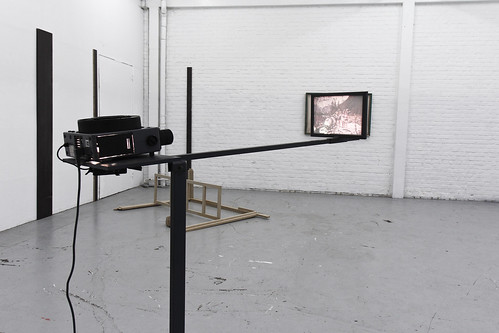
Klaas Vanhee. crox 491 (maart 2015), project in de kubusruimte. ROOM. Een erotisch prentenkabinet.
> encyclopedie > neitsabes dranoc
Verf Na Van Eyck (2014). The Air Bubble. Video en verklarende tekst plus 11 vertalingen: Engels, Grieks, Chinees, Italiaans, Lets, Turks, Lithouws, Koreaans, Russisch, Spaans en Frans. Presentatie in de corridor.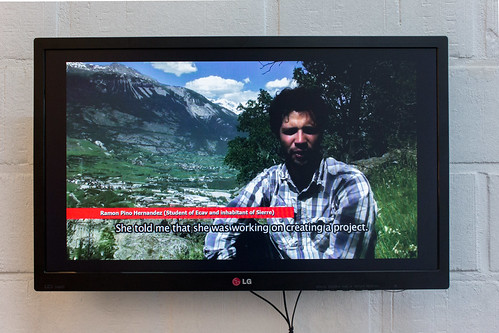
Italiaanse versie: La storia di una bolla d'aria é rappresentata dalla costruzione di una bolla d'aria. Il progetto ha iniziato durante il mese di marzo 2012 a Sierre, in Svizzera, e continua tutt'ora. Il seguente testo spiega il significato di una bolla d'aria e il suo modo di evoluzione. Si puo parlare di una bolla d'aria quando il valore nominativo é superiore al valore reale.
Il valore nominativo esiste soltanto rispetto alla sua definizione. Il valore reale, invece, é il valore presente e puo essere quantificato. Una bolla d'aria raprresenta un valore nominativo e non un valore reale. Ci si puo riferire a una bolla d'aria quanto a un valore nominativo senza valore reale. Esiste soltanto come "idea" senza nessun riferimento alla realtà.
Una bolla d'aria inizia come idea di qualcosa che non esiste in realtà, nell'animo di colui che la crea.
Quando l'idea si trasmette attraverso la comunicazione, la bolla d'aria puo svilupparsi. Le dimensioni della bola d'aria dal grado di scambio di comunicazione. La bolle d'aria si sviluppa quando l'idea si conferma o quando l'informazione diventa valore aggiunto.
Questa evoluzione ha luogo nell'animo della persona portatrice dell'idea. Puo essere causata dal creatore iniziale, da un'altra persona o da qualcosa che si riferisce all'idea. (vertaling: Marie Thérèse Brembilla)
Luchtbelchinees: Danfeng Wu.
Luchtbelgrieks: Katerina Koukaki.
Luchtbellets: Diana Tam.
Luchtbelturks: Soner G.
Luchtbellithouws: Elzbieta Visnevskyte.
Luchtbelkoreaans: Tracy Lim.
Luchtbelrussisch: Zhanna Bobrakova.
Luchtbelspaans: Ramon Pino Hernandez.
I.P.P., Meesterklas Luca, improvisatieproject, 30 maart - 12 april 2015
518. ELF NA TWAALF [ELLEVEN PAST TWELVE]. March April 2016.
Group show. Allora & Calzadilla. Babs Decruyenaere. Benjamin Verdonck. Debby Huysmans. Elle Van Eeghem / Ruben D'Hondt & people & schoolkids of the Malem Island. Hana Miletic. Karl Philips. Kirsten Justesen. Sara Bjarland.
A Group Show. Gastproductie, september 2010. ----> RE:
RE: is een initiatief van Maarten Dings, Joachim Naudts en Egon Van Herreweghe.
Uit Transcriptie 1 /woensdag 8 september 2010/. De adjectieven die M gebruikt:
Belangrijk. Belangrijk. Relevant. Beperkt. Interessant. Groot. Beperkt. Groot. Sterk. Sterk. Noodzakelijk. Overkoepelend. Verschillend. Pragmatisch. Institutioneel. Puur. Artistiek. Institutioneel. Echt. Groot. Interessant. Echt. Goed. Oneerbiedig. Artistiek. Institutioneel. Duidelijk. Puur. Artistiek. Organisatorisch. Flauw. Interessant. Organisatorisch. Individueel. Artistiek. Ontevreden. Artistiek. Organisatorisch. Artistiek. Regelmatig. Goed. Bewust. Organisatorisch. Praktisch. Goed. Interessant. Organisatorisch.
Zaterdag 1 september 2007. Dirty Sweet is een Frans duo, ze treden aan tijdens de openingsavond van een Frans-Belgische productie en spelen lounge jazz.
Inge Braeckman over het werk van Dirk Zoete: Hoewel ze kinderlijk getekend zijn kunnen ze nooit door een kind betekend zijn. Ze verbeelden wat je een 'discorps' zou kunnen noemen. Iets tussen corpus en discours, dus, waarin assonanties en dissonanties samen resoneren in één 'volmaakt' geheel. Het anatomische keurslijf van het lichaam en van de tekening wordt doorbroken.
Uit Careful Dressage, crox-boek nr 19, blz. 228.
'Aangezien steeds drie kunstenaars interactief omspringen met het werk van hun voorgangers, blijft het discours levendig.' (Inge Braeckman over Brainbox, H-art N°14, december 2006)
Fragment uit 'Kunst en onderzoek: een gesprek met Joëlle Tuerlinckx' (Koen Brams & Dirk Pültau, DWR, juli-augustus 2006), blz 6:
J.T.: Vinden jullie ook niet dat de dimensie van het onderzoek tegenwoordig door te veel kunstenaars op de voorgrond wordt geplaats?
K.B./D.P.: Ja, precies.
J.T.: Dan begrijp ik jullie al wat beter. Ik heb de indruk dat het woord onderzoek letterlijk aan het leeglopen is. Stilaan verliest het alle betekenis die er potentieel in vervat zit, de betekenissen die men er ooit aan heeft willen geven of die man eraan dacht te kunnen geven. Ik vind het eigenlijk nogal banaal te zeggen dat een kunstenaar zoekt. Het is het eerste wat je kan voelen wanneer je een atelier binnenkomt: de immateriële sfeer van het onderzoek. Maar nu maakt zowat iedereen aanspraak op dat woord. Het beleeft een inflatie en wordt naar geschoven als een 'strategie'.
1. Het pleistoceens marktdiscours van de als avantgardekunstenaar vermomde kutlulfabrikant. In de wandelgangen van het knuffelknusse contemporaneo krijg je vaker met dinosaurisch discours te maken. Als er geen inhoud is, bestaat het niet, maar daar staat dan weer tegenover dat zelfs een leeg bierblikje inhoud heeft.
2. Het gebakken-lucht-discours. Het ik-weet-nergens-van. In het ene geval omdat hij of zij inderdaad zo goed als niets weet, wat de snuggerste van beiden ook als zodanig toegeven zal, in een ander geval omdat het halsboordje knelt en de persoon in kwestie de overigens niet levensnoodzakelijke informatie waarover hij of zij beschikt niet vrijgeven wil. In sommige gevallen het holle alsof van een zelfverklaard genie.
Het kan op z'n Bommels natuurlijk: deftig, zuinig, zonder grootspraak en terecht erudiet. De pralines van de jetsetkut met de zure smaak van ochtendurine. Net de geur van het urinoir ontbreekt en is er net zo vaak teveel aan.
Het perpetuüm immobile van de in tomeloze ijver over zichzelf uitglijdende gladprater.
discorps Inge Braeckman over het werk van Dirk Zoete: They represent what might be termed a 'discorps', between corpus and discourse, in which assonance and dissonance resonate in one 'perfect' entity. __ Uit Careful Dressage, crox-boek nr 19, Dirk Zoete, blz. 16.
In the mid nineties culture editor for Het Volk [local Ghent newspaper of conservative/popular/catholic tendency]. reviews crox 22 (>Herr Seele), crox 25 (>children's drawings) and crox 70 (schilderkunst hedendaags belgisch).
1. ART MACHINE. March 1990. A dozen in situ made bric-à-brac assemblages, informal and handsome. The flowerpot has a dice inside, and the dice got dot one upside. Many hundreds would follow. foto: ec
2015 = 353 After Dodo
Het 353ste jaar na dodo valt samen met het 2015de uit de christelijke jaartelling.
In 1652 waren het Volkert Iversen en zijn mannen die, voor een tussenstop op Mauritius aanbeland, op een rotsbult net buiten de kust de laatste exemplaren van de dodo opmerkten, naar de rotsbult roeiden en na alle op de rotsbult aangetroffen exemplaren gevangen en middels halsrechting gedood te hebben naar Indië voeren.
In 2008 evenwel vonden ze op Mauritius, diep in een grot, de overblijfselen, het intussen als meest intacte overblijfsel van een dodo bekend staande restant van dodo Fred, zoals ze het restant noemden.
Weinig is bekend over het vocabulaire van de roofmier en hoe zij de dingen noemen.
Met de Britannica, waarin Vicenzo Capello nooit opgenomen werd, de roofmier wel, zal het niet aan publiek ontbreken.
Uit Diezelfde ochtend (Horizonten en meer, Johan De Wilde en Rik De Boe, G262 Antwerpen, 2015):
'Van de dodo weten we dat het laatste exemplaar in 1662 opgepeuzeld werd. Volkert Iversen en zijn mannen hadden toen Maritius als tussenstop. Op het eiland vonden ze, zestig jaar nadat de homo sapiens er voor het eerst voet aan land zette, niet één dodo. Ze kamden het eiland uit, vonden niet één dodo. De laatste exemplaren zaten op een eilandje net buiten kust, wat Iversen niet ontging. Ze roeiden naar het eilandje. Er stond geen wind.' (tekst: Laura van)
Een pluspunt met de dodo: we weten dat hij bestaan heeft en opgepeuzeld werd, wat met die andere iconografische paljas rudimentair gesproken heel erg twijfelachtig is.
2008. crox 282, Adam Geczy (AU). Burried Alive, een video-presentatie. Een maand later begint in zelfde ruimte crox 289, TVF art doc cinema.
Tijdens de openingsavond, eind november 2008, de periode combineert projecten van Lien Nollet, Sander Buyck en Adam Geczy, presenteert Geczy Toasting on the World Food Crisis with a Bottle of Dom Perignon, een performance die hij speciaal voor die avond had bedacht. In een editie van Australian Monthly gaat hij dieper in op de betekenis van dit project. Het is het eerste deel van een drieluik. In 2010 volgt het tweede deel, Remember To Forget The Congo. Toasting on is een studie naar levend model, de economisch crisis. Geczy redeneert over wat we wereldwijd aan armoede hebben en ledigt een fles Dom Perignon. --->Geczy
'My previous exhibition in late 2008 at the
experimental art space in Ghent, Croxhapox, was
accompanied by the performance, Toasting the world food
crisis with a bottle of Dom Perignon. It was a piece whose
idea came from those rare occasions when, on savouring an
expensive meal or wine, one momentarily feels a pang of
shame when the mind strays to consider the logical force of
such extravagance in terms of our normal weekly expenses.
But if we then transplant these scruples into the realm of
demography, it is as if when eating a steak, the suppressed
shame of the routine terrors of the slaughterhouse must
now also extend to the plight of underprivileged humanity.
When we indulge in an expensive wine we could be feeding a
village. Bon santé.
Over several months I amassed mostly arbitrary
statistics of the cost of food and labour in various African
countries relative to a sip of Dom Perignon, the luxury drink
par excellence. Based on an average price of US$200, one
sip equates to around $8, and its translation into the
activities of the 'developing' (developing into what?) world is
crushing. During the performance I sat below a screen and
slowly consumed the bottle, my face painted a pale blue for
defamiliarisation. A litany of statements divided into short
phrases pulsed away in an almost inexorable rhythm: ‘In
Guinea-Bissau, the average annual gross income is $200,
which is the average price of a bottle of Dom Perignon’, or ‘In
Bangladesh well over half the population live on less than a
dollar a day. That is, about 12% of a single sip’. By the
second draught of wine I felt disgusted, which suggested
that the performance was working its negative magic over
me, and possibly over those watching it. Unusually, the
audience stood largely rooted to the spot, entranced and
appalled by the spectacle.'
Fragment uit Remember To Forget The Congo; The Monthly,
juli 2010.
QUIJOTE, titel van crox 431, een project van de Duitse kunstenaar Eric Pries.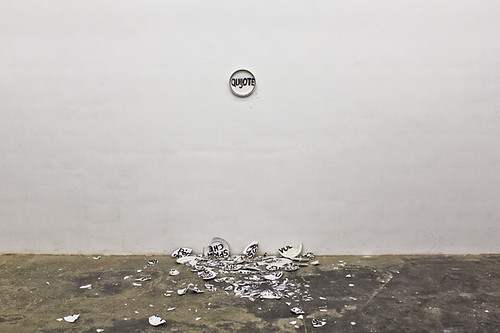
24 juli 2014, dag 3 van de performance van Isabelle Stockmans: 'Isabelle zit aan tafel. Ze hield Cervantes voor bekeken, probeerde
Dante, hield na verloop van tijd ook Dante voor bekeken, las Op Oloop
van de Argentijnse schrijver Juan Filloy. In het schriftje op de rode
tafel in de hall, waarin ze 's ochtends of 's nachts wat directieven
noteert, staat dat ze Op Oloop bijzonder onderhoudend vindt. Er staat
niet of ze Op Oloop uitlas of de traditie van 70 blz aanhield.'
Voor Isabelle begon het inderdaad met het idee om Don Quichote uit te lezen en zich daarna aan La Divina Comedia van Dante te wagen. Geen van beide zal ze uitlezen.
1996. OPEN DEUREN, crox 51. Locatie 70: DOORWAY ROCK. Pascal Verbeken, de bewoner van Nijverheidsstraat 30, stelt de gang van zijn woning ter beschikking voor een reeks concerten. Het buurtproject heeft twee weekends, 28/29 september en 5/6 oktober. Doorway Rock is enkel op zondag 6 oktober van 14u tot 19u30. Het programma van de concertnamiddag wordt door Pascal Verbeken samengesteld: Fabian Schweiger, Moon, Blue Orbit (Merlyn Paridaen & Adriaan Verwée), Bart Maris en Filip Wauters, Fred Maenhout en Armand Bourgoignie, Luc Devos, Frank Clarysse, Els Dedecker, Frank Moeyersoons. Zo staat het in de brochure.
In De Morgen - KUNST VAN DEUR TOT DEUR, vrijdag 27 september 1996 - gaat het als volgt: 'Soms worden de grenzen van de plastische kunst overschreden, zoals in het geval van Geertrui Daem. Zij leest voor uit eigen werk, weliswaar alleen op 5 en 6 oktober, in de Nijverheidsstraat nr 78. Elders in dezelfde straat wacht een drukke koncertagenda met optredens van Luc De Vos, Bart Maris, Kommil Foo en anderen. Maar er zitten uiteraard ook kunstenaars in het aanbod die gewoonlijk wel tot het gebied van de beeldende kunst worden gerekend.'
Recensies in De Standaard. Periode 1998-1999.
Verhalen in stof. crox 77: Dianna Frid. 16 februari 1998.
Schriftuur. crox 79/80: Ignace De Vos & Dirk Peers. 17 juni 1998.
Texaans licht. crox 82/83: Holger Nickish (DE) & Hartwig Schwarz (DE). 9 september 1998.
Flitsen van voorbijgangers. crox 86/87: Thomas Huyghe & Zjuul Devens. 9 december 1998.
Pure poëzie. crox 88/89: Anton Cotteleer & Patricia Thornley (US). 13 januari 1999.
Bloedrood. crox 92/93: Marc Maet & Michaël Borremans. 10 maart I999.
Ruwe bolster. crox 97/98: Larry Krone (US) & Johan De Wilde. 9 juni 1999.
TEXAANS LICHT 'Croxhapox start het nieuwe seizoen zoals gebruikelijk met twee nieuwe tentoonstellingen. De Duitser Holger Nickisch en Hartwig Schwarz zijn toevallig allebei afkomstig uit het Ruhrgebied, maar daar houdt iedere vergelijking op.
Vooral Nickisch is indrukwekkend met een installatie op de eerste verdieping. Een aantal jaren geleden bracht hij een half jaar door op de ranch van Donald Judd in Texas. Daar raakte hij diep onder de indruk van diens werk en collectie, maar ook van het landschap. Dat resulteert in kleine sculpturen die opgebouwd zijn uit verschillende lagen hout en die sterk doen denken aan het geërodeerde Texaanse berglandschap.
De inmiddels in Amsterdam wonende Nickisch is van oorsprong meubelmaker en weet dat op een boeiende wijze te verenigen met zijn kunstenaarschap. Hij bouwde een soort archiefkast waarin hij al het werk voor deze tentoonstelling kon vervoeren. Het meubel kan worden opengeklapt en doet dienst als een soort uitstalkast. Bovenop is er plaats voor een kleine diaprojector met beelden die Nickisch tijdens zijn verblijf in Texas maakte. Aan een kant van de kast brandt een merkwaardig blauw licht: het doet, aldus Nickisch, denken aan het Texaanse ochtendlicht. In de verschillende laden van het meubel liggen werktekeningen, maar ook houten objecten. Ze krijgen in de laden het aura van kostbare juwelen die eruit genomen mogen worden om ermee te spelen. Zo kan ieder op op de vloer zijn eigen Texaanse berglandschap maken.
Van Hartwig Schwarz is in de kelderverdieping een in situ-werk te zien dat beduidend minder interessant is. Schwarz maakt foto's van op elkaar gekleefde affiches die hij op straat ziet. Hij maakt van die foto's zelf affiches en plakt daarmee de ruimte gedeeltelijk vol, net zoals een daarin opgebouwde houten schutting.(1) Het werken met de affiches benadrukt voor hem de voorlopigheid van iedere daad. Theoretisch niet slecht, maar de uitwerking kan maar matig boeien.' Edith Doove, De Standaard, Woensdag 9 september 1998
VERHALEN IN STOF 'Croxhapox behoort tot het uitstervende ras van de onafhankelijke tentoonstellingsruimtes. Dat het in een behoefte voorziet, mag blijken uit het grote aantal kortlopende tentoonstellingen dat er elk jaar plaatsheeft.(2) Daarvoor worden kunstenaars uit het hele bereik van de hedendaagse kunst uitgenodigd, van jong tot oud, van net beginnend tot min of meer gerenommeerd.
Sinds een tijdje gebruikt men niet alleen de kelder, maar ook de eerste verdieping. Dit keer is de jonge Canadese, in New York wonende Diana Frid van de partij.(3) De tentoonstelling werd mede samengesteld door de Nederlandse curator Kie Ellens. Frid heeft een heel eigen manier van werken. Ze werkt graag met stof en handwerktechnieken, zoals borduurwerk. Ze plukt haar beeldmateriaal uit allerlei didactische boeken en brengt dat dan op een bepaalde manier op stof over. Die verknipte ze vervolgens weer, en assembleert ze in labyrint-achtige vormen of boeken.
In haar beeldmateriaal heeft Frid een voorkeur voor plattegronden van musea en afbeeldingen van Eerste Hulp bij Ongelukken. Leidraad is haar onderzoek naar narratie en de mogelijkheid die op niet-lineaire wijze weer te geven. Het verschijnen en weer verdwijnen van verhaallijnen, maar ook van materie op zich, is daarbij een duidelijke rode draad. Op enkele mindere werken na een heel geslaagde tentoonstelling.'(4) Edith Doove, De Standaard, Woensdag 29 april 1998
PURE POËZIE 'Bij Croxhapox loopt een verrassend poëtische tentoonstelling met werk van Anton Cotteleer en de Amerikaanse Patricia Thornley.(5) Cotteleer maakt een heel sobere opstelling met licht surrealistische objecten. Een vogelkooi met stoffen beschermhoes is als een Singer-naaimachine met een tafel versmolten - waar ze elkaar raken valt er een gat in de tafel. Even verderop staat een klein rood plastic emmertje. Het diertje dat je in de kooi zou verwachten vind je hier in terug - geen vogeltje, maar een eekhoorntje dat dood en opgezet ligt te zijn en op zijn beurt versmelt met zijn omgeving.
Tenslotte staat er nog een lage tafel. Ik zie ze als zitbankje van waaraf het hiervoor beschreven schouwspel gade geslagen kan worden. Gelukkig ga ik er niet op zitten, want het tafelblad dat met zijn nerven en kringen bedrieglijk op echt oud hout lijkt, is een membraan dat heel langzaam op en neer beweegt. Daarin ligt de kracht van Cotteleers werk - al zijn werken lijken te ademen, omvatten een soort leven.
De kooi/tafel geeft de indruk een vogeltje te herbergen dat er voor kiest niet te ontsnappen via het gat in de tafel, het eekhoorntje lijkt vredig te slapen en is zo tevreden over zijn omgeving dat het dezelfde kleur heeft aangenomen. En de tafel tenslotte ademt echt.(6)
Op een heel andere manier is ook het werk van Patricia Thornley interessant. Ze toont installaties waarin het huis en ook huiselijkheid op een afstandelijke, technische manier geobserveerd worden. Vijf objecten, die bij nader inzien wellicht allemaal onderdelen van een spoelbak zijn, verschuilen zich achter een matglazen plaatje. Een reusachtige tv-antenne blijkt verbonden met een heel klein televisiescherm. Een helm projecteert via zijn zoeklamp het beeld van een schutting of een klein huis op de wand.
In een reeks kleine zwart-wit foto's toont ze een bepaald soort huis. Thornley komt via deze combinatie op een voorzichtige, intimistische manier tot een heel sterke betrokkenheid met haar onderwerp.' Edith Doove, De Standaard, Woensdag 13 januari 1999
SCHRIFTUUR 'Ignace De Vos werkt al jaren aan een heel eigen schriftuur in zijn schilderijen. Daarbij spiegelt hij zich aan een bepaalde Amerikaanse traditie die voor hem nog altijd veelzeggend is. De schilderijen die hij bij Croxhapox toont, laten een voor De Vos bekend stramien zien. In brede stroken plaatst hij wijn wolkachtige structuren in horizontalen en verticalen over elkaar. Het is een langdurig proces, waarin De Vos naar een balans zoekt. Ik betrapte mezelf erop dat verschillende van zijn schilderijen een biologerend effect hebben. De sterke gelaagdheid ervan en de verrassende kleurnuances nodigen uit tot langer kijken.
In de loop van de jaren is De Vos steeds transparanter gaan werken. De verf wordt doorgaans zeer dun aangebracht, maar in somige gevallen overschildert hij zijn doeken met een egale laag. Dwars daardoor blijft de oorspronkelijke opzet zichtbaar. Twee egale doeken die hier hangen, werken als contrapunt. Het zijn gesloten beelden geworden, die doen verlangen naar wat er onder dat pistachegroen of zwart verborgen ligt.
De Vos vertrekt voor zijn abstracties doorgaans van figuratieve beelden. De spanning tussen figuratie en abstractie wordt voortgezet met het werk van Chris Peeters(7) dat een plaats in de kelderruimte heeft gevonden.
Peeters begint een vaste waarde in het aanbod van Croxhapox te worden. De ruimte is gevuld met kleurige papieren, die hij bewerkt met allerhande sjablonen. Het zouden soms patronen voor stoffen kunnen zijn, en Peeters zou zeker geen slechte illustrator zijn. Voorlopig laat hij deze tekeningen echter nog voor zich spreken.' Edith Doove, De Standaard, Woensdag 17 juni 1998
FLITSEN VAN VOORBIJGANGERS 'Zo vaak als de schilderkunst dood verklaard wordt, staat ze ook weer op. Zo werd provinciale prijs van Oost-Vlaanderen in 1997 weliswaar gewonnen door een uitstekende fotografe, Elke Boon, maar er waren ook boeiende schilders bij de laureaten en bij de geselecteerden voor de tentoonstelling. Ik denk dan vooral aan Michaël Borremans, Ans Nys en Thomas Huyghe.
Laatstgenoemde was een van de laureaten. Zijn schilderkunst valt op door een grote aandacht voor het lichamelijke en is verwant met die van een Francis Bacon of Marlene Dumas. In zijn reeks De kus, maar ook in zijn Boksers, vloeien lichamen en lichaamsdelen op een intrigerende manier in elkaar over. Bij Croxhapox in Gent toont hij nu een deel van een nieuwe, dertigdelige reeks Portretten.
Je kunt zien dat dit geen willekeurige hoofden zijn, maar regelrechte portretten zijn het ook niet. Huyghe trekt voor deze reeks met een camera de straat op en vraagt aan voorbijgangers of hij ze mag fotograferen. Dat doet hij van heel dichtbij. Uit het beeldenarchief dat hij zo opbouwt, haalt hij de elementen voor zijn composiethoofden. Die worden vervolgens met een woeste urgentie op het doek "gesmeten". Een schilder die zeker in de gaten gehouden moet worden.
De techniek van de montage die Huyghe op zo'n boeiende manier in zijn werk incorporeert, wordt op een heel andere manier ook gebruikt door Zjuul Devens die eveneens in Croxhapox exposeert. Devens werkt met video, maar blijft - en dat is een manco van veel videokunst - te veel in het technische kunstje hangen. Tegelijk hanteert hij zijn techniek net iets te slordig.
Een citaat uit Mulisch' roman De aanslag aan de muur geeft aan dat een besef van het verleden moet samengaan met een besef van toekomst. Devens beeldt dat uit door met een kano de Zuid-Willemsvaart en de Maas te bevaren. Op de voor- en achtersteven plaatste hij een camera. De beelden daarvan monteert hij in één beeld, zodat je op de ene helft met de kunstenaar meevaart en op de andere kunt zien wat hij achter zich laat. Maar juist op de al te strakke scheidslijn tussen beide beelden loopt het jammerlijk mis.' Edith Doove, De Standaard, woensdag 9 december 1998
BLOEDROOD 'Een bijzondere combinatie in Croxhapox, waar tekeningen van Marc Maet en schilderijen van Michaël Borremans te zien zijn. Op twee verdiepingen wordt onafhankelijk geprogrammeerd, maar soms vallen de twee tentoonstellingen mooi samen en dat is nu zeker het geval.
Michaël Borremans brengt een nieuwe reeks schilderijen die allemaal rond het idee van de fetisj draaien. Elk schilderij toont een voorwerp of lichaamsdeel dat op symbolische of directe manier aan die omschrijving voldoet. "Fetisjeren" betekent voor Borremans iets op het dodelijke af liefhebben. In die zin is een afbeelding van een nietmachine symbolisch op te vatten: zij houdt de dingen letterlijk muurvast, verstikt ze.
Opvallend in deze reeks is het herhaalde gebruik van cadmiumrood. Nu eens in een voorwerp, zoals de nietmachine of een paar laarzen, in die merkwaardige kleur geschilderd. Op andere momenten ligt het geheel of gedeeltelijk als een filter over het beeld heen. Terwijl je op je as ronddraait en de schilderijen rondom je bekijkt, schiet dat rood steeds opnieuw je oog binnen. In het "ruimtelijk" gebruik van zijn schilderijen ligt zeker Borremans' kracht. Ze kunnen op zichzelf bestaan, maar zijn vooral sterk in hun combinatie.
Ook de tekeningen van Marc Maet hebben een indringende werking. Nadrukkelijk hoog opgehangen, dwingen ze als het ware aandacht af. Het is een bizarre reeks van mooie beeldcitaten en -ideeën, met verwijzingen naar kunstenaars als Picabia, Zurbaran, Beuys, Araki, maar ook Magritte.(8) Maet toont zich daarbij geregeld de schilderende criticus van de Belgische kunstscène.' Edith Doove, De Standaard, Woensdag 10 maart 1999
RUWE BOLSTER 'Een heel ander soort intimiteit vind je terug in het werk van de Amerikaanse kunstenaar Larry Krone. Ooit vertrokken vanuit een meer minimalistische, conceptuele houding maakt hij tegenwoordig vooral patchwork.
Krone verdiept zich in de verschillende steken die hierin van oudsher gebruikt worden, maar maakt er vooral hilarische werken mee. Crazy lijkt in eerste instantie een nijver stukje huisvlijt, maar ontaardt - zoals de titel doet uitschijnen - in waanzin. Het rustige quilt-patroon wordt steeds maniakaler en eindigt in een uithoek in de titel van het werk.
Krone eigent zich op eenzelfde eigenzinnige manier ook de uiterlijkheden van de country & western toe. In het patroon van zelfontworpen bandanas blijkt taal al evenzeer verstopt te zitten als in de kralenketteingen die hij uit stripverhalen maakt.
Na al dit handwerk doen de tekeningen van Johan De Wilde op het eerste gezicht aan kruissteekpatronen denken. In de kelderverdieping van Croxhapox toont hij een deel van de reeks tekeningen waaraan hij nu al zo'n zes jaar werkt.
Het uitgangspunt is een vierkant van 50 x 50 cm. Daarop toont hij een inventaris van vaststellingen aan de hand van landschappen, gebruiksvoorwerpen, architectuur en stillevens. Al die beelden vertrekken van een minutieus uitgewerkt basispatroon, waarop De Wilde tijd en zijn herinnering loslaat. Stuk voor stuk hebben deze afbeeldingen een sterk autobiografische achtergrond. Het onderzoek naar de plaats van het zelf komt ook tot uiting in een mail art-project waarvoor De Wilde naar alle landen van Europa een brief aan zichzelf verstuurde.(9) De bizarre tips die De Wilde in zijn brieven opneemt, keren onverrichter zake terug, omdat zijn Gentse adres in het buitenland uiteraard onbekend is.' Edith Doove, De Standaard, 9 juni 1999
(1) Wat onvermeld blijft, is dat het project van Schwarz als diptiek gepland werd. Het tweede, andere deel is gedurende enige tijd in de Gentse straten te zien, waar Schwarz, onder andere aan het Sint-Pietersplein, muren volplakt met roze affiches. De presentatie in het souterrain maakt weinig indruk.
(2) Ter vergelijking. In 1998 hadden we 17 projecten, tien jaar later, in 2008, klokken we af op 70.
(3) Verhalen in stof is de eerste recensie van ED over een crox-project. Net voor het project van Dianna Frid hadden we projecten van Ward Denys en Jan De Cock.
(4) In 2006 heeft Dianna Frid, die dan niet langer in New York woont, een tweede crox-project.
(5) Het traject van jaartal 1999, wat begint met de presentaties van Anton Cotteleer en Patricia Thornley, is een opeenvolging van interessante presentaties. Het is ook het jaar waarin De Morgen en De Standaard de projecten van croxhapox van nabij volgen. Van alle projecten zijn er uiteindelijk slechts drie waarover niet geschreven werd. Een wereld van verschil met hoe het er nu aan toegaat. Sinds 2003 is in De Morgen en De Standaard niet één keer over croxhapox geschreven.
(6) Later zou Anton nog een versie van de tafel maken, als ik me niet vergis. De ademende tafel is een meesterwerk. Over het project van Anton Cotteleer werd ook heel erg gauw een beslissing genomen, herinner ik me. Het ging kort op de bal. De evocatie van ED is accuraat. In de ruimte stonden drie objecten, meer was er niet. We hadden bezoekers die in de deuropening bleven staan en meteen rechtsomkeert maakten.
(7) Edith heeft de naam fout, het gaat om Dirk Peers.
(8) Op wat familie en vrienden na weet helemaal niemand van hun bestaan af.
(9) Een praktijk die bekend staat als Indirect Correspondence. Het poststuk gaat van A (afzender) via B (foute locatie) naar C (de gadresseerde). Er zijn varianten. De variant die Johan De Wilde gebruikt, is de meest interessante als je er ook iets wil mee doen: de niet afleverbare stukken worden gertourneerd naar het adres dat als afzender vermeld staat.
1995. crox 31, Öl Öl Öl. Paintings. The series, and it literally involves a real series, something really serial and moreover in the very sense of the word series, offers at each stage something white, or several white things, on a traffic-blue background. Slices of bread, comic strip thought balloons with ETC. ETC., mushrooms, it could have been a row of pollard willows or another kind of tree, I thought it resembled mushrooms, a meeting of mushrooms, and I still think so, there are lines of chalks, there is a sheep, there are michelin men and a caravan. With this set of paintings, some twenty in total, van drives at neckbreaking speed to Berlin, in 1995, some three weeks before christmas, in the Skodapox, all of them just fit in the back, no place left to add another one. After the crox project, October 1995, the serie was shown in Tatort, an art space in Kreuzberg.
Fabian Schweiger in concert at opening night in croxhapox, in the basement of Aannemersstraat 54.
1.
Zou ik twee pintjes mogen hebben?
Mag ik vier pintjes?
Zou ik trouwens nog twee pintjes mogen hebben?
Laura, mag ik een pintje?
Heb je nog een pintje voor me?
Zou ik nog een saison bio mogen hebben A.U.B.?
Zou ik mogen vijf pintjes A.U.B.?
Heb je schweppes A.U.B.?
Nog een pintje.
Excuseer, kan ik hier iets bestellen, mijnheer?
Is er nog saison dupont?
Zou ik nog vier pintjes kunnen krijgen A.U.B.?
Mag ik nog iets bestellen?
/crox-box, zaterdag 11 april 2015, openingsavond Meesterklas Luca/
2. drankkaart anno 2014
Achel blond
Achel bruin
appelsap bio
biolégère, van brouwerij Dupont
bionade: vlier, lychee, gember/sinaas, kruiden
Gageleer bio
Grans Moments, een cava
Hommelbier
Hoppils
Koffie
La Trappe blond
Martens pils, ook bekend als een wilfriedje
Moinette bio, van brouwerij Dupont
Orval, voor zover te krijgen
Rochefort 8
rode wijn
Saint-Feuillien
Saison Dupont bio
Saison Goliath, vroeger Gouyasse
Saison Voisin
schweppes
sinaasappelsap bio
Spa bruis
Spa plat
Thee
Valeir, het pornografische bier
witte wijn
lente 2016:
minus: Achel bruin, Hoppils, Martens pils, Valeir
extra: 13 (Gentse pils), Blanche de Namur, Cécémel, La trappe tripel & quadrupel
droge worst (bio)
crox 277-5, BRAINBOX2 unit 5: Bart Dhaluin, Gerd Ververs, Reinhard Doubrawa - January 2009
1. In the brainbox room (the large room at the back) a stove is installed.
2. The scraps of paper from unit 4 are burned in the stove.
3. A table is set at the centre with a projector to show youtube movies.
4. Gerd brought in an homungenous pile of firewood.
5. Chapatis, or something similar, were baked, and during closing night there are pancakes.
crox 344, BRAINENLARGEMENT - a project in the cube room - October 2010 till February 2011
About a 150 photos are shown in a wall cupboard especially designed for the project
crox 350, BADABOOM - a project in the large space at the back - February till March 2011
'Reinhard Doubrawas Blick auf die Absurditäten des Alltags ist ernsthaft, amüsant, aber nie cynisch. Er hält scheinbar belanglose Moment fest, die er für bildwürdig erachtet. Oft sind es Bilder des Verfalls, Ort und Zeit sind nicht erkennbar. Es entsteht jeweils nur' Isa Bickmann (from Special Values, Salon Verlag 2009)
From NEWS (Salon Verlag 2004); Interview, Maria Anna Tappeiner spoke to Reinhard Doubrawa on January 20th, 2004 in Cologne. (fragment)
Q. The "Spiegel" is a news-magazine (Nachrichtenmagazin). It presents its topics with a certain interest in sensation.
A. Further pleasures have emerged for me from this desire for sensation and the "News" project, e.g. the series "Alarm, I was there too" (Alarm, ich war dabei). These are front cover subjects or the main weekly topics. I made cut-outs in white paper of these images. The original photographs are far more sensationalist than the "News" series and often depict personal tragedy: floods, wounded people or a sinking ferry. These are title pictures that appear in other media too. I am interested how these pictures change me. How do I become part of this information and how do I then continue working with it, e.g. by communicating with friends? Where does the individual place himself in the collective?
Q. What does making pictures mean to you as opposed to consuming pictures?
A. Consumption is faster and consuming influences further consumption - or, to possibly put it in better way - how one percieves in future. Your question is important especially in the context of these fast processes. They continue to work in me and influence me. That I find interesting. I make the drawing to understand this process. I want to be able to grasp this information. We are surrounded by a lot of fast information but we live and work mainly out of the subconscious. This constitutes is as human beings and lets us react spontaneously. What is still possible when I know about all this terror? I need to build a strong wall around myself to still be able to be happy (or sane). Also personal interaction requires this blocking-out mechanism.
Appears three times in the programme of 2010. Firstly during the end-of-year presentation of the 2nd bachelor MMV KASK. That was late June. Early November there is MAYBE FROM SCRATCH, the same group of students, now 3rd bachelor MMV. A few weeks later follows TANTAMOUNT Gent Kanazawa, a Timelab project by Dries Douibi and Annelien Vermeir.
Douibi's most eyecatching object, in the presentation of late June 2010, is a projector on a block of ice. The image from the projector is a roll of kitchen paper.
Member of the board from late December 2011. Became treasurer on 24 January 2012.
>Predemocratic Republic
De meest zuidelijke eilandengroep van de Predemocratische Republiek, gelegen in de Golf van Guinea, West-Afrika. Met het meer noordelijk gelegen Nigri-Pez tegelijk ook het meest oostelijke gebied van het archipel.
Baele, Bart
Böing, Thomas (D/ Köln)
Borremans, Michaël
Borremans, Xenia
Boudia, Samir
Brouckaert, Hedwig
Buta, Florin Solo project in 2005. Apart from a vast collection of recent paintings on small unframed panels, and two less recent works on canvas, the artist as well exhibits a small series of mixed media drawings, some of it on fragments of newspaper.
Cosijns, Sylvain One of the many participants of ‘Open Deuren (Open Doors, crox 51/ 1996), a big event in the crox-neighbourhood. Second project in collaboration with Philippe Vandenberg (crox 96/ 1999), involving a publication titled ‘De Boodschapper’ (The Messenger).
De Brabander, Stef
De Brabandere, Mario
Defrancq, Evert
Degand, Pieter Participates in Basics 1 (drawings, crox 110) and has a solo project in 2004. The solo project offers a mix of paintings, drawings and sketches.
De Vos, Ignace 1991 A contribution to the first edition of the copy art project. The fotocopied drawing – showing the rooftop of a house and clouds above it - suggests a strong influence by Jean Brusselmans. It is no copy art in the real sense of the word, but rather a sample of fotocopied art.
De Wilde, Johan
D’hondt, Lieve
Dierickx, Karel
Duhamel, Sylvie
Duyck, Kurt
Gentils, Frans
Hauser, Thomas (D/ Berlin)
Herr Seele
Kamagurka
kinderen Machariusschool Gent
Krone, Larry
Lagast, Peter
Lerooy, Thomas
Leus, Nicolas
Maet, Marc
Mead, Stu (US)
Mentens, Ruth
Mistiaen, Carlo
Musschoot, Griet
Paridaen, Merlyn
Peers, Dirk
Pittoors, Tinka
Posman, Andre
Spie, Merlyn
Timmermans, Ante
Vandekerkhove, Karien
Vandenberg, Philippe
Vandenbrande, Daniël
Van der Borght, Joris
Vanderlinden, Carole
Vandersleyen, Ann
Vande Veire, Maud
Vandevelde, Ludwig
Van Meerssche, Jos
Van Stapele, Nicoline
Vermeersch, Pieter
Vermeersch, Robin
Zoete, Dirk
Concertavond van Morctapes op maandag 23 november 2009 met sets van het Zweedse Library Tapes, het Amerikaanse Drekka en Filmjölk, een Belgische formatie. Drekka, herinner ik me, is best een omvangrijk groepje. Ze zijn met een man of vijf. Na de set doen we een groepsfoto.
Scenery, LeerlingMeesterproject Kunstpodium T (Tilburg), 2015.
Enkele substantieven uit het woordje uitleg van Dina: Werkproces. Tijd. Materiaal. Actie. Keuze. Omstandigheden. Tijd. Intuïtie. Overgave. Enjoyment. Zwart en wit.
Werkwoorden uit zelfde tekst: fungeren, staan, spelen, volgen, zetten, zijn, werken, geven, produceren, zien. Werk in situ. Niet tijdig droog en hierdoor als vloerobject gepresenteerd.
Videofilm alleen operatief tijdens openingsavond.
Mei 1990, twee maanden na de eerste activiteit, wordt het vzw opgericht. Er zijn drie stichtende leden: Hans, Frank en Guido.
De locatie op het eerste van Beverhoutplein 7 bestaat uit drie kleine kamers. Paraplastique Hystérique, de eerste crox-solo van Sjoerd Paridaen, is een triptiek.
Het zestiende crox-project, 'Zelfportretten' (mei 1991), is het laatste project aan het Beverhoutplein. De stichtende leden van croxhapox vzw tonen elk een zelfportret: Suenos oniricos (Frank), Kunst-Zaken (Guido) en Aber ein Jaegerschnitzel (van).
De derde bijdrage aan de eerste editie van het Copy Art project (1991) is een werk van Frank Van den Eeckhout.
De derde locatie van 'En Passant' (1991) - een instalraam van Hugo De Leener - is in de Sint-Pietersnieuwstraat.
Net als aan het Beverhoutplein is het derde project in de Aannemersstraat een solo project van Edwin Carels.
Derde locatie van het buurtproject Open Deuren (1996), in de gang van Aannemersstraat 179, is een werk van Dirk Peers.
Voor de tweede editie van het instalraamproject (1995-1997) beschikt croxhapox over drie locaties: Onderstraat 51 (het huidige Pink Flamingo's), Onderstraat 26 (vanaf september 2003 vaste instalraam-locatie) en Serpentstraat 28 (waar tot voor kort Stripwinkel De Schaar was).
Voor Schilderkunst Hedendaags Belgisch (1997) brengt de Waalse kunstenaar Marc Angeli drie karmijnrode monochromen in.
crox 101 (2000), een project in CC Strombeek-Bever, op uitnodiging van Luk Lambrecht. Carte Blanche aan Croxhapox - drie kunstenaars: Jan De Cock, Dirk Zoete, Anton Cotteleer.
Het derde instalraam uit zelfde periode is 'Ambassade van de Predemocratische Republiek' van Stefaan Dheedene. In 2005 is een project van Stefaan Dheedene het eerste in crox3.
Het derde project in de zaal voorin, februari 2005, is dat van de Roemeense kunstenaar Florin Buta.De derde openingsrede, tijdens de vernissage van crox 26, een solo-project van Dirk De Neef, heeft 'De eerste openingsrede' als titel (zie Urk Piw).
De derde publicatie - los van de croxcards - is 'De Boodschapper' (1999) een gelimiteerde en door Philippe Vandenberg geredigeerde editie ter gelegenheid. De losbladige documenteert het duoproject van Philippe Vandenberg en Sylvain Cosijns en bevat een fragment uit 'Kopnaad', een theaterstuk van Stefan Hertmans. Het derde crox-boek is dat van CarianaCarianne, Borders (2006), een essayistisch kleinood.
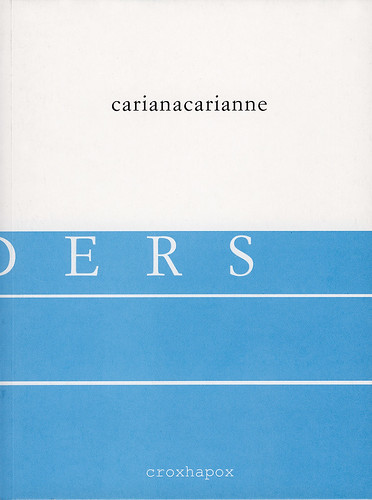
Brainbox, een transformatieproject, waarbij elke groep drie titularissen heeft. Uitzondering hierop evenwel is unit 1 van de tweede editie uit 2008-2009: KAMP telt vijf leden, unit 8 van de tweede editie waarin - naast Thomas Böing en Hans Demeulenaere - Vincent de Roder en Jan Wiels als duo aantreden, en unit 4 van de derde editie uit 2013 met Benjamin Verdonck, Dirk Zoete en The Fabulous Bruce Brothers, te weten Frank & Robbert en Robbert & Frank.
Unit 1 van Brainbox#1: Peter Morrens, Johan De Wilde en Ward Denys. Tijdens de eerste editie is het unit 3 die voor een inhoudelijk keerpunt zorgt. Laura van treedt aan als performer. /foto: mc/
Unit 3 van Brainbox#2: Maud Vande Veire, Antoine Van impe (Luik) en Honoré d'O. Unit#3 van Brainbox#3: Kelly Schacht, Stijn Van Dorpe en Antoine Van Impe.
Brainbox#3, herfst 2013, begint met een ingreep van Michaël Borremans, Hannelore Van Dijck en Miet Warlop.
De derde bezoeker is nooit de eerste bezoeker, hoewel niet uitgesloten kan worden dat hij of zij dat ooit op een dag toch is.
De derde bezoeker is soms de eerste bezoeker: mama en papa duwen de kinderwagen meestal voor zich uit zodat de in de kinderwagen zittende, van het binnentredende bezoekerspotentieel in principe het aanhangsel, toch als eerste over de drempel rollen komt.
De derde medewerker met documentatie/archief als hoofdmotief is niet Cristina Amelia Candea maar Nima Bahrehmand. Beiden werkten een Master af aan Beeld & Installatie, School of Arts, Kask. Cristina Amelia gaat meteen na haar stage voor croxhapox werken, begin 2012, en wordt nog datzelfde jaar gedurende korte periode vervangen door Nima. Aan het van zomer 2013 treedt ze toe tot het crox-team.
De persoon die als derde, sinds het in voege treden van het Kunstendecreet, het zakelijk beleid waarneemt, na Joris Van der Borght (2005-2008) en Laura van (2008-2009), is Stefaan Van Ryssen.
Van eind 2012 tot zomer 2014 heeft het artistieke team 3 leden: Jelle Clarisse, Dries Douibi en Laura van.
De solo projecten van Christophe Lezaire, grand coloriste wallon, drie in totaal en merkwaardig genoeg altijd in confrontatie met ander werk. Het eerste project (2005) tijdens de eerste editie van Basics#2, het tweede (2007) in een confrontatie met werk van Pieter De Clercq, het derde (2013) geconfronteerd met werken van Alda Snopek en Ivan Adriaens.
Het eerste door Nima Bahrehmand voor en in croxhapox samengestelde project heeft POV Realities Revisited Part Three als titel.
Lens Na Spinoza (2015) krijgt de vorm van een drieluik: drie veeleer korte etappes, het tweede traject het kortste, met fotografisch werk van 10 kunstenaars.
Geïntroduceerd door Samira El Khadraoui. Drury en Verwimp initiëren en coördineren When is a house?, een productiemodule die ze eerder opgestart hadden. Artistieke en zakelijke leiding van het Berlijnse APA–B.
583. WHEN IS A HOUSE? 1. Locatie De Wasserij, Toekomststraat 38, 9000 Gent. 29–31 maart 2019. Astridcollectief, Joël Verwimp, Lindsey Drury.
Friday 29 March, 20:00, Open Meeting.
Saturday 30 March, 11:00, Five Scores : 24h Golden Society by Wandau Dubrau; Handeln vom Nullpunkt by Mari Brellochs; Run by Lindsey Drury; Le déjeuner sur l'herbe by Joël Verwimp; Immanence & Inconstancy walk into a bar by Drury&Verwimp.
18:00, Open Session. Sunday 31 March, 11:00, breakfast.
589. WHEN IS A HOUSE? 2. GLITCH GAME FOR ASTRID. Locatie CAT Cologne, Köln, 24–25 May 2019. Astridcollectief, Lindsey Drury, Joël Verwimp.
A score by Drury&Verwimp, to be performed by Astridcollectief; commissioned by croxhapox and supported by CAT Cologne and PAErsche.
610. WHEN IS A HOUSE? Topic: When is a house? 8m2 – the smallest unit of permanence. Speaking in new narratives: hearing collective histories & common dreams. Exchange project. 28 February – 6 March 2022. Uncommunicated location. Joël Verwimp & Lindsey Drury, Astridcollectief, 90x4' collective (Tbilisi): Nino-Ana Samkharadze, Thoma Sukhashvili, Mano Svanidze, Giorgi Rodionov.
Supported bu the European Cultural Foundation i-Portunus.1
[1] The i-Portunus Pilot Scheme is implemented on behalf of the European Commission, coordinated by the European Cultural Foundation (Amsterdam); the i-Portunus Houses Consortium involves Mitost (Berlin) and the Kultura Nova Foundation (Zagreb).
Fragment uit de zaaltekst van Echo, groepsproject uit 2013: 'Marcel Duchamp voyait dans "l'apparence allégorique" un repos instantané, une pose extra-rapide, l'exercice de l'oeil moderne, rapide et fulgurant, tendu entre présent et passé et conservant ouvert cet écart fût-il aussi fin qu'une lame, aussi rapide qu'un éclair.' Tekst: Michel Couturier.
510. Instalraam. Window project. Onderstraat 26, 9000 Gent.
Januari februari 2015.
2003. crox 110, BASICS 1. More or less 200 drawings by 25 artists all in all. At the same time, a bit earlier or later maybe, Sylvie Duhamel has a solo project in Space Is The Place, a project of Merlyn Paridaen in the basement of Aannemersstraat 54.
Adler, Gosbert - solo project 1996 - title: interiors - photos
Barath, Heike-Kati - solo project 1999 - paintings
Bogers, Britta - solo project 2008 - drawings & paintings
Boïng, Thomas - solo project in 1998 & 2006 - NOTES, crox-book Nr 4
Brand, Jens - installation window i/c/w Phill Niblock 1996 - title: Hot Spot
Brehmer, Andreas - fourth man of The Singing Painters from May till November 1998
Dorn, Antje - solo project 1995 - title: öl öl öl - paintings
Doubrawa, Reinhard - cube project: brainenlargement 2010 /photography/
Graf, Hartmut - copy art project 1992 - fotocopy art
Hainke, Wolfgang - copy art project 1992 / Verzamelwoede 2007 - fotocopy art
Hauser, Thomas - solo project 1997 - drawings & paintings
Heise, Juliana - solo project 1996 - title: flexibele Einrichtung - installation
John, Franz - copy art project 1992 / Verzamelwoede 2007 - fotocopy art
K, Bruno - does a proposal for signos 1992 - maquette
Karz, Thomas - installation window 1996 - intervention 2005 - participates in BASICS 2, 2005-2006
Krabbe, Peter - copy art project 1992 - fotocopy art
Kubiczak, Harald - installation window 1996
Kuwert, Doris - installation window 2005
Mead, Stu (US/ lives and works in Berlin) - 2004
Nickish, Holger - solo project 1998
Olbrich, Jurgen O. - copy art project 1991-1992 - fotocopy art
Pries, Eric - Ueber Revolution als Frage des güten Geschmacks 2010 /video/
Schulze, Oliver - duo presentation with Heike Kati Barath 2008
Schwarz, Hartwig - solo project 1998 - installation & street intervention
Sommer, Martin - solo project 2010
TEMPORARY CITY Berlin - 2009
Vorfeld, Michael - installation window 1996
Weber, Claudia - RE: 2010
Westphal, Sarah - installation window 2009
Wolff, Renate - solo project 2004 - titel: genTRaum - wall painting
Woensdag 26 september 2007, een concertavond van Smeraldina-Rima. Ryan Jewell (US), John Wiese (US) en DUIVVV (BE). Ryan Jewell en DUIVVV treden aan in de zaal achterin, John Wiese in de mediaruimte.
2008, GM groepsproject. -->Decock -->Grunewald -->Escallier
crox-box fragment 14 oktober 2008
De kubus wordt donderdag. In crox is Nicolas Durand bezig. Hij sliep in
de kubus. Je lui demande: 'Il y avait des moustiques?' En Nicolas, met
bijna godsvruchtige verbazing: 'Ah, mais non, pas de moustiques.'
Er
is een enveloppe van Grégory, de vijfde. Ik neem de trap naar het
kantoortje en vraag Nicolas of hij die brieven van Grégory al gezien
heeft. En Nicolas, verbaasd, alsof ik zijn verbazing op de proef stel:
'Ah, mais non...' Het zijn handgeschreven brieven, leg ik uit, en elke
bladzijde is een letter. Ik open een van de enveloppes. Nicolas sliep in
de kubus, hij zegt het alsof het er eigenlijk niet toe doet, een mens
slaapt zoals het uitkomt. In een Frans stadje, vertelt iemand, sliep
iemand in het urinoir van een openlucht zwembad, had net voldoende geld
om vanuit Parijs de trein naar Brussel te nemen. Het zijn dingen die
gebeuren. Er gebeurt zoveel.
Natalie telefoneert me en er is telefoon van Susan. Honoré wil weten of het werk van Cathérine nog te bezichtigen is.
Het is een prachtige dag, meer zomer dan herfst. Aan de sluis is het water in een woelige beweging.
De
kubus op het woonerf is ontmanteld. Nicolas heeft de bekisting
verwijderd. Kinderstemmen overrompelen de buurt. Jarne en het jongere
broertje zitten voor een huisdeur. Nicolas legt uit dat de kubus eerst
oranje geschilderd - morgen, overmorgen misschien, eerst moet het ding
drogen - en dan met professioneel materieel tot gruzementen herleid zal
worden. Is niet het eindpunt van het traject. De gruzementen worden door
een dipsaus van fel oranje gehaald en hierna opnieuw gedecimeerd.
In
de grote zaal is een berglandschap van zwarte keitjes. De keitjes zijn
vochtig, wat de zwarte kleur verklaart. Hoeveel kruiwagens - twintig?
Als de massa uitgedroogd is, zal Nicolas er een 'quadrillage' over
aanbrengen, een ruitpatroon in fluoverf.
Mijn slaapkamer is niet een bed, hier niet, in Parijs niet, in Trouville niet. Het is een bepaald raam, een bepaalde tafel, het gewend zijn aan zwarte inkt, aan onvindbare aanstrepingen in zwarte inkt, het is een bepaalde stoel. En bepaalde gewoontes die altijd dezelfde zijn. [Schrijven, blz. 11]
Food Matters, All You Need Is The Lavatory 2, voetnoot 12/t.
Wat me aan het zwarte tafeltje doet denken, het zwartetafeltjeconcert van Hans Beckers: een bepaald raam, een bepaalde tafel, het gewend zijn aan zwarte inkt, aan onvindbare aanstrepingen in zwarte inkt.
Daniël Dutrieux (BE/Liège) is one of the first artists to confirm his participation in Signos, the aborted 1992 project. He and Kari Caven (FI) both propose sculptures in the form of a pole, which closely fits in the original concept of the street project.see werkvergadering see signos
Dutrieux's work was appointed a lawn in Citadelplek. What I remember of the project is the idea that the shadow the meters high pole would paint on the lawn was emphasised as the crucial element of the work, as well in the first design drawings as in the maquette.
2004. crox 129, instalraam op locatie Onderstraat 26.
2005. crox 145 BASICS 2.
2006. crox 145 sequel.
2007. crox 239. Schilderproject. Groepsproject met Carole Vanderlinden, Gerd Ververs, Florin Buta (RO), Ian Kesteleyn en Stef De Brabander.
crox-card 58: zonder titel, acryl op papier, collage (2007)
crox-card 59: zonder titel, acryl op papier (2006)